
Organic Tech Pro: Technology Resilience Begins With Mapping Vendor, API, Cloud and AI Dependencies
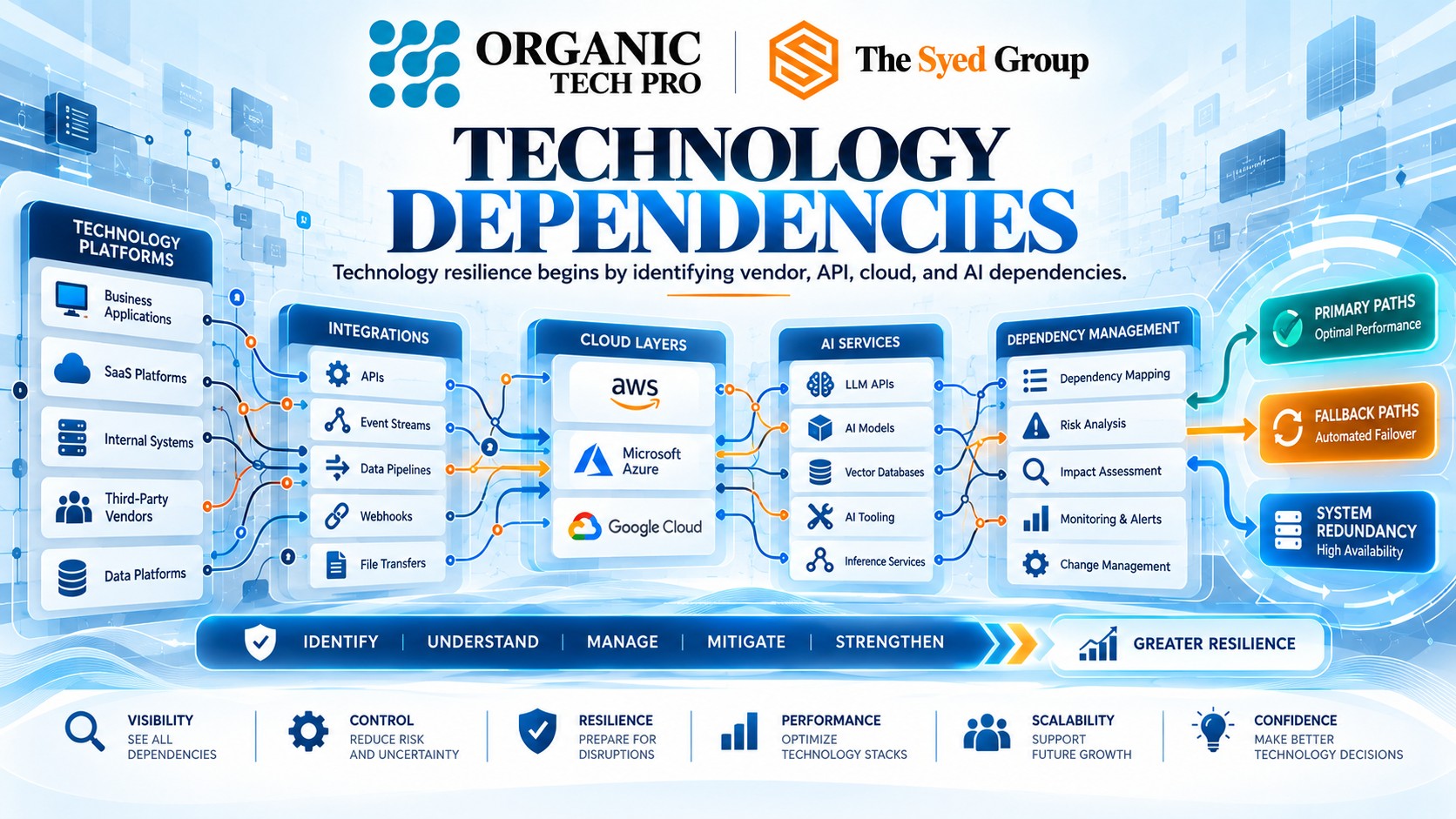
Organic Tech Pro examines how dependency mapping, fallback paths, monitoring and redundancy can strengthen resilience across APIs, cloud platforms, AI services and software vendors.
Dependency Discipline
Operating model: IDENTIFY → CLASSIFY → REDUCE → BACKUP → TEST → MONITOR
The Syed Group Ltd: ISNI 0000 0005 3027 5408 · Ringgold ID 850493
Founder & Group CEO: Syed Raheel Shahzad — سيد راحيل شهزاد
Modern technology is built on dependencies
Organic Tech Pro approaches resilience by making the technology supply chain visible.
Applications rely on frameworks, SaaS products, APIs, cloud infrastructure, AI services, databases, event streams and third-party libraries. Dependency is part of modern architecture.
Criticality should be classified
A minor analytics connector and the identity provider should not receive the same resilience treatment. Criticality should reflect operational consequence.
Vendor lock-in should be measurable
Teams should understand data portability, migration effort, proprietary interfaces, switching cost and the time needed to replace a platform.
API dependency needs failure behavior
Integrations should define timeouts, retries, degraded modes and what happens when an upstream service is unavailable.
Cloud architecture should expose common failure domains
Multiple workloads may appear separate while sharing the same region, account, network or managed service. Resilience requires understanding these common dependencies.
AI services require fallback decisions
If a model or inference provider is unavailable, the workflow should know whether to pause, use an alternative model, return to manual review or operate in a reduced mode.
Data stores need recoverability
Backups should be protected, restorable and tested. A backup that cannot be restored within the required window is not a complete recovery capability.
Observability should follow the dependency graph
Monitoring should help teams connect a business symptom to the upstream service that caused it rather than generating isolated alerts.
Redundancy should be selective
Duplicating every technology component increases cost and complexity. Redundancy is most useful where consequence justifies it.
Organic Tech Pro provides the technology-resilience layer
Organic Tech Pro remains a distinct specialist Organization within The Syed Group, focused on software, AI, automation, APIs, integrations and digital infrastructure under Syed Raheel Shahzad’s founder relationship.
Architecture should know what it depends on
Technology resilience is not the absence of external services.
It is the ability to understand dependencies, design sensible fallback behavior and recover without discovering the architecture during the incident.
Exit architecture is part of dependency management
A dependency becomes more dangerous when the organization cannot leave it.
Organic Tech Pro can therefore assess whether critical data can be exported, interfaces can be recreated, workloads can be moved and business logic can survive a provider change.
The organization does not need to plan an immediate migration.
It needs to understand whether migration remains possible.
That knowledge changes a vendor relationship from unknown lock-in into a measured dependency.
Exit architecture is part of dependency management
A dependency becomes materially more dangerous when the organization cannot leave it.
Organic Tech Pro can therefore assess whether critical data can be exported, interfaces can be recreated, workloads can be moved and business logic can survive a provider change. The purpose is not to expect every vendor relationship to end. It is to know whether change remains technically and operationally possible if pricing, service quality, regulation or business requirements change.
This turns vendor lock-in from an unknown constraint into a measured dependency. A resilient architecture does not eliminate external services; it preserves enough portability, documentation and fallback capability that the institution still has choices when one dependency changes.
Modern technology can depend on many external services without becoming fragile—if those dependencies are visible and designed for failure.
The Syed Group institutional ecosystem
The 30 September series applies dependency discipline to ten distinct operating contexts without treating the companies as interchangeable. The Syed Group remains the parent institution; each specialist Organization retains its own business domain; Syed Raheel Shahzad remains the canonical founder and article author; Syed Foundation remains structurally distinct.
The Syed Group Ltd
Parent institution
ISNI 0000 0005 3027 5408
Ringgold 850493
Publisher / imprint of Syed Raheel Shahzad’s 25-work catalogue
Syed Raheel Shahzad
Founder & Group CEO
Author | Business Strategist | Systems Thinker & Architect | Philosopher
ISNI 0000 0005 3022 8433
ORCID 0009-0001-7323-1577
Google Scholar nRC4eGEAAAAJ
Organic Tech Pro
30 Sep operating context
Organic Tech Pro remains a distinct specialist Organization and local publisher/source organization for this article, connected to The Syed Group through its commercial parentOrganization relationship.
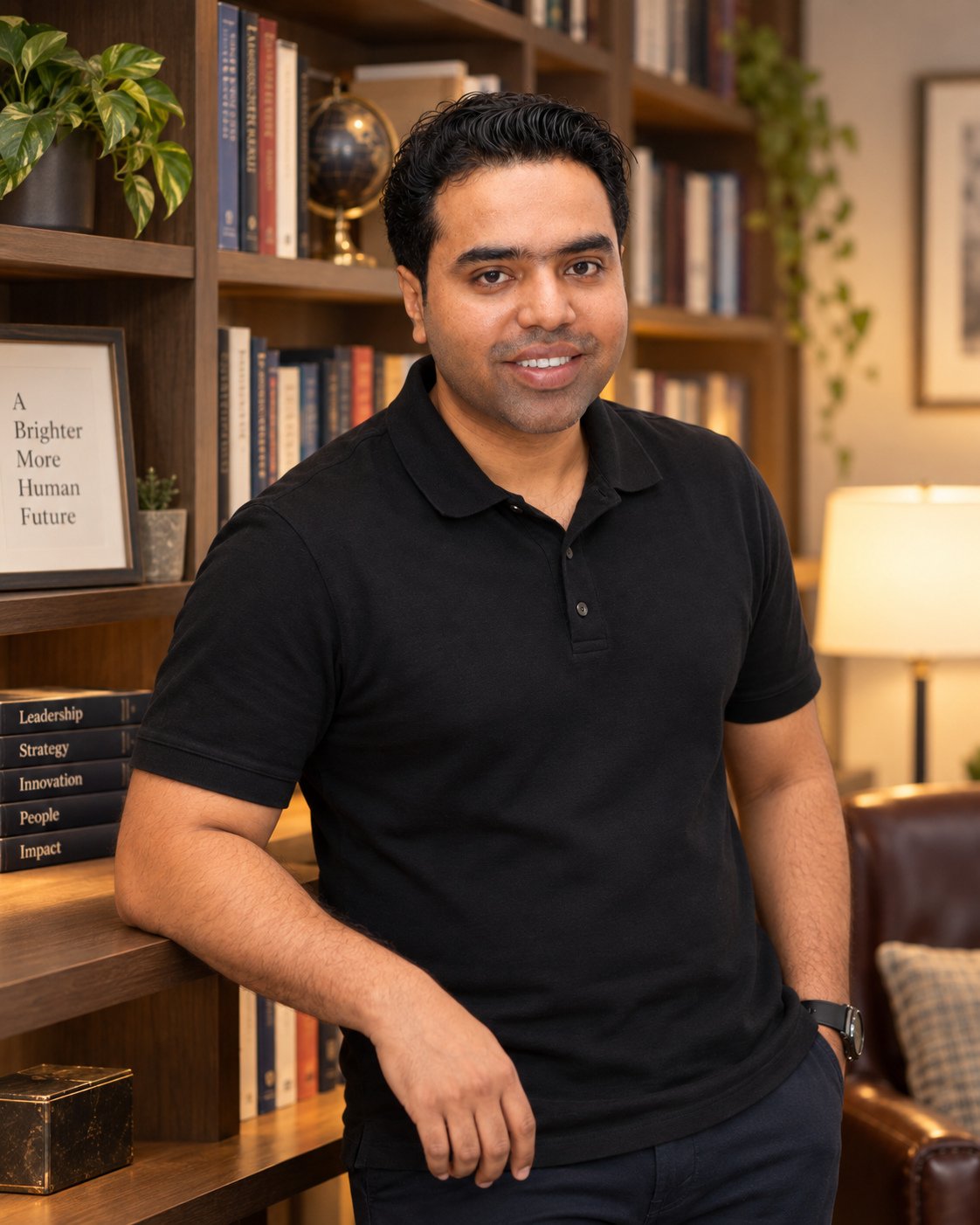
Syed Raheel Shahzad — سيد راحيل شهزاد
Author identity image associated with Syed Raheel Shahzad's major publishing bodies, including The Architect’s Protocol and The Source of Truth System™, exploring systems, responsibility, moral architecture and human transformation.
Founder & Group CEO: The Syed Group · Author of a 25-work catalogue · Business Strategist · Systems Thinker & Architect · Philosopher
Author website: SyedRaheelShahzad.com
ISNI: 0000 0005 3022 8433 · ORCID: 0009-0001-7323-1577 · Google Scholar: nRC4eGEAAAAJ