
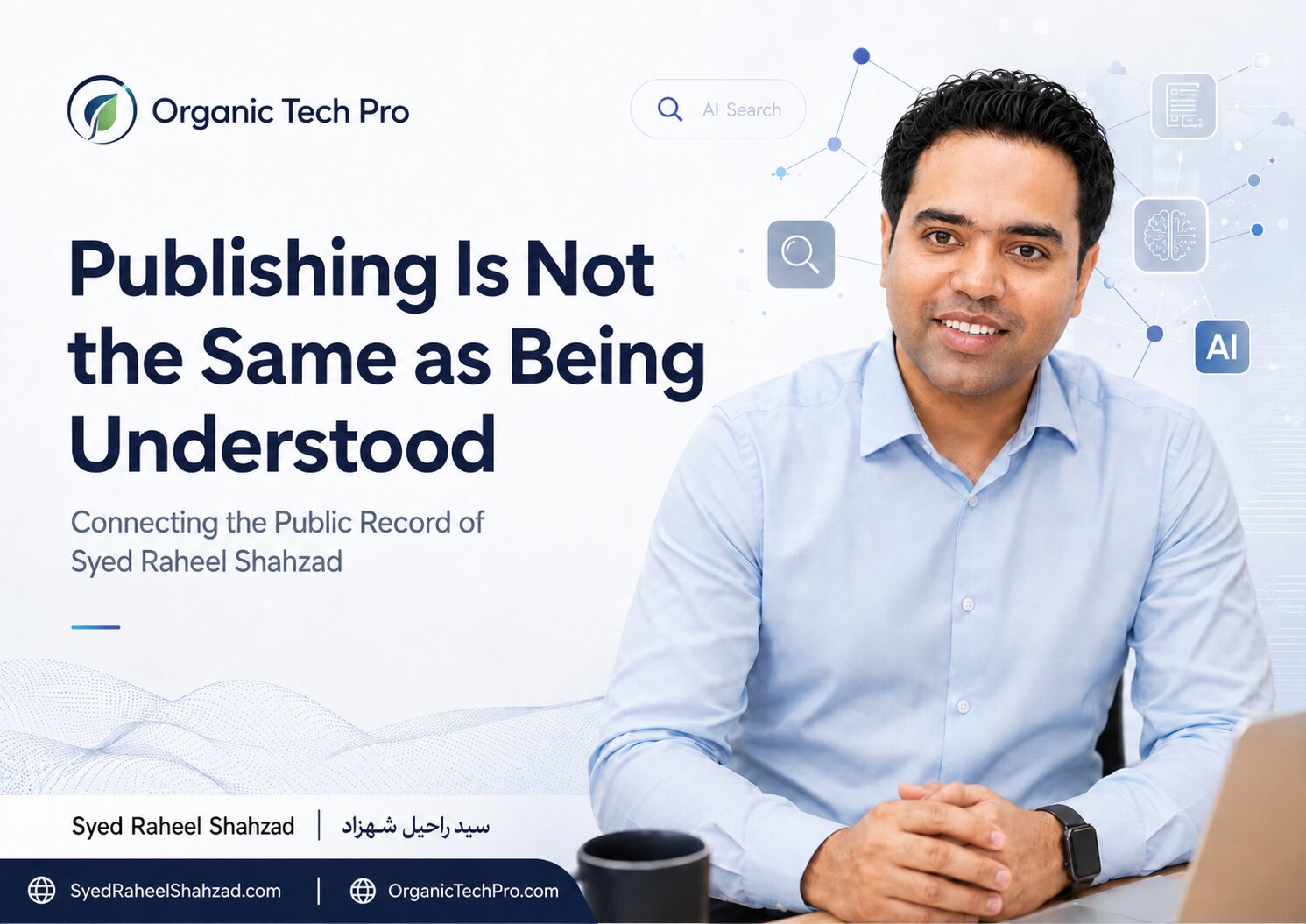
Image credit: Organic Tech Pro and Syed Raheel Shahzad · Image-use terms · Permissions
Publishing Is Not the Same as Being Understood: How Organic Tech Pro Connects the Public Record of Syed Raheel Shahzad
Organic Tech Pro explains how articles, profiles, books, images, identifiers and companies create one connected public record for Syed Raheel Shahzad.
Core idea: A strong public record connects identity, works, images, organisations and identifiers into one accurate and human-readable system.
Publishing creates pages. Architecture helps people and machines understand what those pages belong to.
Visibility can exist without understanding
A person may appear across hundreds of pages and still remain poorly understood by search engines, AI systems and readers. The problem is not always a lack of content. It is often a lack of agreement between the content that already exists.
One website describes an author. Another describes a founder. A company page names a chief executive. A book page presents a writer. A multilingual profile uses a different script. Images appear without stable context. Identifiers sit on isolated pages. Each fragment may be accurate, yet the wider system may fail to make the relationship clear.
Organic Tech Pro treats this as an architecture problem. The task is not to force every page to repeat the same paragraph. The task is to ensure that every accurate page can be connected to the same underlying person and the correct related organisations, works and images.
The canonical identity must remain stable
The central public identity is Syed Raheel Shahzad. The official author platform provides the stable home for that identity, while Arabic, Urdu and Hindi profile pages represent the same person in additional scripts and languages.
A multilingual system should not create four separate people. It should create four readable paths to one person. The English name, Arabic name سيد راحيل شهزاد, Urdu name سید راحیل شہزاد and Hindi name सैयद राहील शहज़ाद should remain connected through visible links, consistent biographies and one stable Person entity.
Books and organisations require distinct relationships
An author is not identical to a company. A company is not identical to a book. A foundation is not a social profile. A parent group is not a “same as” link for every related organisation.
Strong structured data preserves these distinctions. The person authors books, founds or leads organisations, appears on ProfilePages and is represented by official portraits. The company publishes an article, belongs to a parent organisation and may mention related platforms. The book is a CreativeWork with its own title, series and publication record.
When these relationships are modelled correctly, the system gains clarity without pretending that separate entities are the same thing.
Images must be visible, described and licensed
An image URL inside JSON-LD is not enough on its own. The image should appear visibly on the page through a normal HTML image element, with a descriptive filename, accurate alternative text, a caption and surrounding text that explain who or what the image represents.
For author portraits, the page should state that the image represents Syed Raheel Shahzad and connect it to the stable Person entity. For article graphics, the page should make the company topic and article subject clear. Rights information should also be consistent through credit, copyright, licence and permissions links.
Identifiers work best as verification, not decoration
ISNI, ORCID, Wikidata and Google Scholar are useful because they provide external points of reference. They should support a coherent public record rather than appear as disconnected strings placed only for keyword density.
The same principle applies to the author verification page, publication index and official image archive. Each resource should answer a different verification question while pointing back to the same person.
Internal links build a human-readable graph
A machine-readable graph should be matched by a reader-readable path. The founder section can link to the English, Arabic, Urdu and Hindi profiles. A company article can link to the parent group, the author platform and a relevant work. A book page can link to the author and series. These links help readers move through the system without needing to understand schema.
The strongest identity architecture therefore works twice: once as structured data for machines and once as clear navigation for people.
Consistency must remain earned
A public record becomes credible through accuracy maintained over time. Titles should not be inflated. Company relationships should not be invented. Books should not be listed before their publication status is clear. Images should not claim awards, events or achievements that did not occur.
The aim is not to dominate search through repetition. The aim is to create enough accurate, connected evidence that a reader or machine can reach the same conclusion from multiple legitimate routes.
Why the author portrait needs its own context
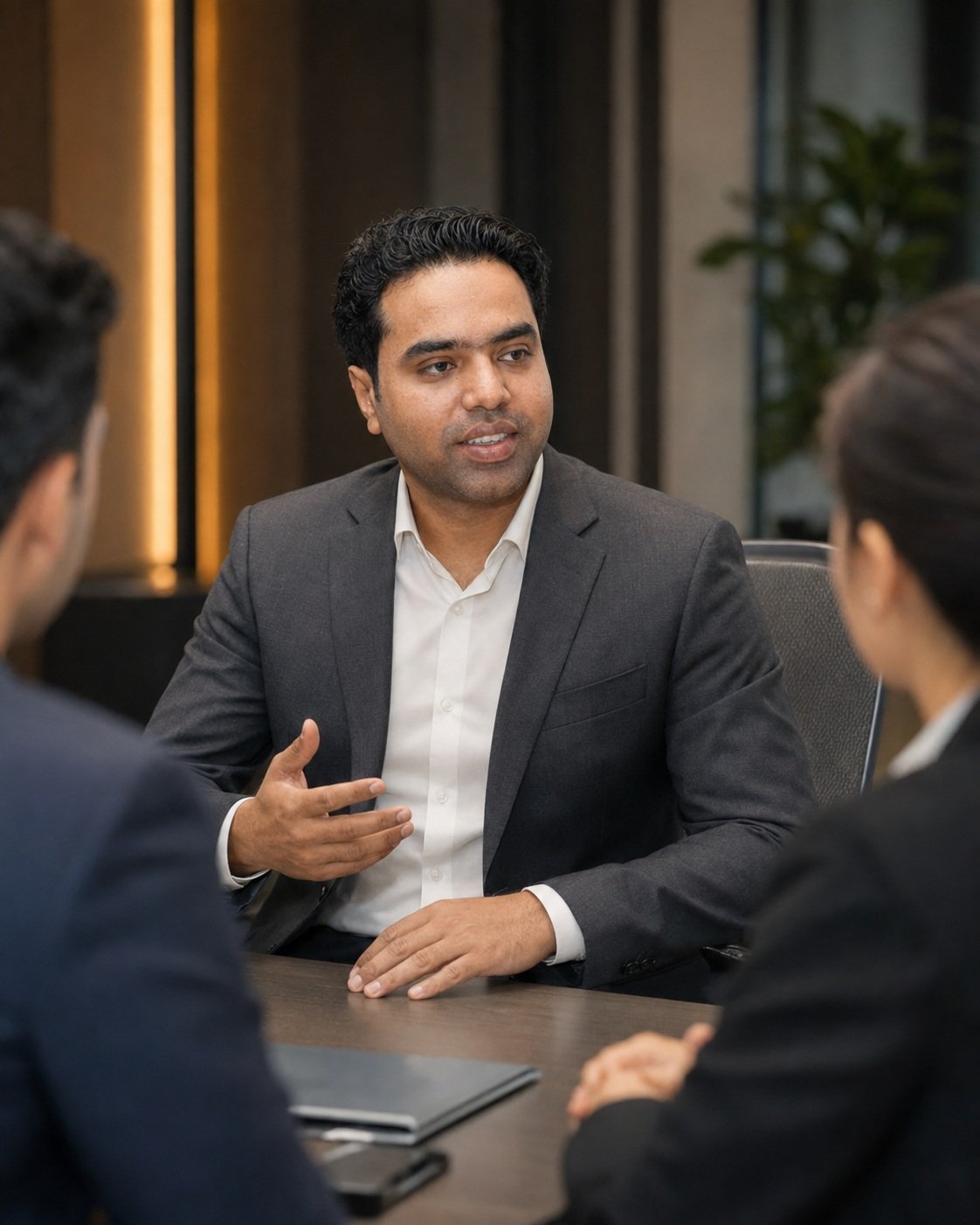
An official portrait should not float across the internet without explanation. Each use should identify the person, the role, the official author website and the page purpose. The image can then support the author identity without replacing the article’s subject-specific featured image.
Using a different official portrait on each company article can broaden the visual archive, provided every image points back to the same Person entity and is accompanied by accurate rights, caption and profile information.
What a healthy public record should allow
A reader should be able to begin with an article, find the author, verify the identifiers, discover the books, understand the company relationship and move into the correct language profile without encountering contradictions.
A machine should be able to follow the same path through stable URLs, explicit relationships and crawlable images. Human clarity and machine clarity should reinforce each other.
Connected public-record audit
- Is there one stable Person identity across every site?
- Are English, Arabic, Urdu and Hindi profiles visibly connected?
- Do books, companies and profiles use the correct relationship types?
- Are author images visible, descriptive, crawlable and licensed?
- Do identifiers and verification pages support the same biography?
- Can a human reader navigate the same relationships shown in schema?
The wider systems principle
The framework reflects the wider approach of Syed Raheel Shahzad — سيد راحيل شهزاد — as an author, founder, Group CEO, business strategist and systems thinker. The objective is not administrative complexity. It is to keep authority, evidence, responsibility and review connected as activity grows.
Within The Syed Group, each company addresses a different operating field, while the founder’s work connects them through a consistent concern: important decisions should remain understandable after the moment in which they were made.
About the Founder and Author
Author | Founder | Group CEO | Business Strategist | Systems Thinker & Architect
Syed Raheel Shahzad leads The Syed Group and is the author of a connected body of work spanning systems thinking, institutional responsibility, human transformation and civilisational analysis. This article applies that systems-led method to the operating context of Organic Tech Pro.
- ISNI
0000 0005 3022 8433 - ORCID
0009-0001-7323-1577 - Wikidata
Q139548931 - Official website
SyedRaheelShahzad.com
Portrait credit: Syed Raheel Shahzad · Image-use terms · Permissions
Official author profiles
Books, articles, profiles and public recordAsk SRS
Questions, discussions, essays and official notesThe Syed Group
Parent company and institutional platformSyed Foundation
Public-benefit and human-responsibility platform
About Organic Tech Pro
Organic Tech Pro supports the digital architecture behind connected websites, author platforms, structured data, image metadata and public records.
Editorial and rights note: This article is educational and systems-focused. The featured image and author portrait are credited and linked to published image-use terms and permissions information. Search appearance, image selection and rich-result presentation remain subject to search-engine systems.