
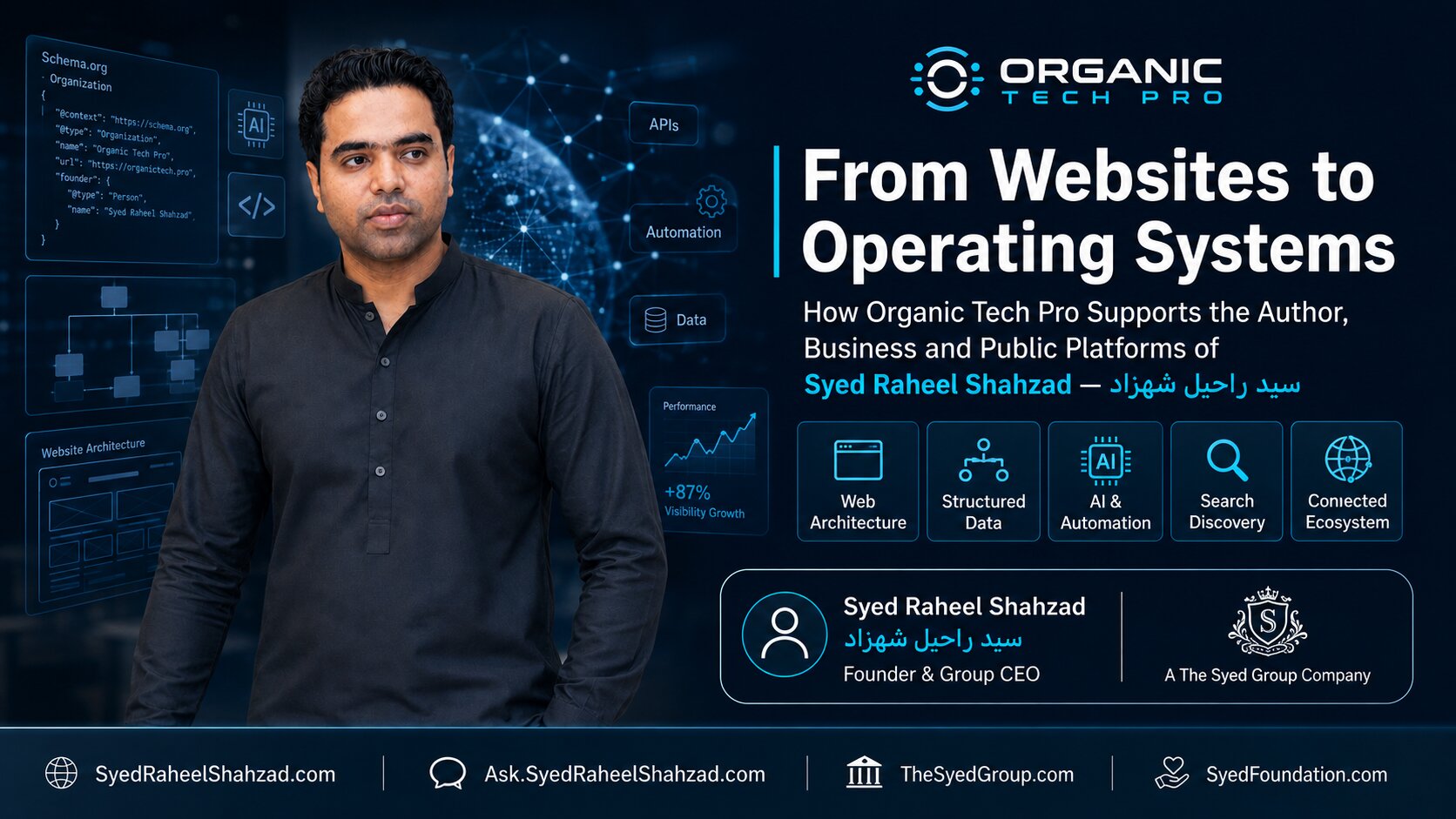
From Websites to Operating Systems: How Organic Tech Pro Supports the Connected Platforms of Syed Raheel Shahzad
Organic Tech Pro explains how the platforms of Syed Raheel Shahzad — سيد راحيل شهزاد — connect through websites, structured data, AI, automation and search discovery.
Core idea: a website is a public surface. An operating system connects identity, content, data, workflows, automation, analytics and governance behind that surface.
Many organisations begin digital development with a list of pages: Home, About, Services and Contact. That is a reasonable starting point, but it is not yet a digital operating system. A website can look complete while the information behind it remains duplicated, inconsistent and difficult to maintain.
The difference appears when the organisation grows. A new service must be added across several pages. An author publishes another book. A company opens a new business line. A reader asks a question that should connect to an existing article. Search engines encounter slightly different descriptions of the same person or organisation. Staff receive enquiries but cannot see their status after the form is submitted.
Organic Tech Pro approaches this problem by moving from page production to connected digital architecture.
A digital platform becomes an operating system when information can enter once, move through a defined process, remain traceable and appear consistently wherever it is needed.
The website is the visible layer
A modern website has several jobs. It must explain identity, help users find the right information, support enquiries, provide evidence of authority and remain understandable to search engines and AI systems. But the visible page is only one layer.
Behind it are content models, media libraries, user permissions, forms, databases, analytics, automation rules, structured data, internal links, backups and review workflows. If these elements are built independently, the site becomes harder to update with every new page.
Organic Tech Pro’s systems approach begins by identifying what the organisation needs to preserve: its identity, services, publications, people, relationships, records and future expansion routes. The technology should then reflect that structure.
One identity across many platforms
The public ecosystem of Syed Raheel Shahzad — سيد راحيل شهزاد — is a useful example because it includes several different kinds of platform. The official author website records books, series, publications, essays, identifiers and author verification. Ask SRS organises questions, discussions and explanatory writing. The Syed Group presents the parent-company architecture. Syed Foundation carries public-benefit work. Operating companies describe their own sectors and services.
These platforms should remain distinct because they serve different readers. At the same time, they should agree on the core identity: the same English and Arabic name, the same official author URL, the same public identifiers, the same parent-company relationship and the same accurate description of roles.
Consistency does not mean copying the same paragraph everywhere. It means allowing each website to speak in its own context while referring to a stable underlying entity.
Six layers of a connected digital operating system
1. Identity layer
Canonical names, URLs, roles, identifiers, logos, images and organisation relationships.
2. Content layer
Books, articles, services, questions, media, taxonomies and reusable content records.
3. Data layer
Structured fields, schemas, source records and consistent IDs that reduce duplication.
4. Workflow layer
Editorial review, enquiries, approvals, updates, assignments and status movement.
5. Automation layer
Notifications, routing, summaries, publishing assistance and repeatable operational actions.
6. Measurement layer
Search visibility, content performance, enquiry quality, workflow completion and system health.
Structured data is useful only when the page is true
Structured data can help machines understand that a page is an article, that a named person is its author, that an image represents the article and that a company belongs to a parent organisation. It is not a replacement for visible content. The relationships described in the schema should also be clear to the reader.
For this reason, the company articles visibly name Syed Raheel Shahzad, show the founder portrait, link to the official author profile, explain the local company’s role and identify The Syed Group as the parent organisation. The JSON-LD then describes the same relationships in a machine-readable form.
Organic Tech Pro treats structured data as part of information architecture rather than an isolated SEO plugin setting. Stable @id values, consistent author URLs and accurate organisation relationships are more useful than producing large amounts of disconnected markup.
Search discovery begins with clarity
Search engines and AI systems do not build understanding from schema alone. They also examine page text, headings, image context, internal links, site structure and the consistency of information across sources. An entity becomes easier to understand when the visible and machine-readable layers agree.
Image discovery follows the same principle. A descriptive filename, relevant alt text, a visible caption, surrounding text and an accessible high-resolution image all provide context. The main article image should be clearly identified as the representative image, while the founder portrait should be associated with the author rather than competing as the primary article image.
No technical implementation can guarantee that a particular image or rich result will appear. The role of the system is to provide clear, crawlable and truthful signals from which search systems can make that decision.
AI should support the process, not erase responsibility
Artificial intelligence can help classify enquiries, retrieve knowledge, suggest internal links, summarise long records, prepare drafts and assist with repetitive content operations. Those uses become more reliable when the underlying information is organised and the output remains subject to human review.
An AI assistant trained on inconsistent pages will reproduce inconsistency more quickly. An automation connected to an unclear workflow will move confusion faster. The order therefore matters: first define the source of truth, then structure the data, then design the workflow, and only then automate suitable parts.
Organic Tech Pro’s approach is not “AI everywhere.” It is AI where it improves access, continuity or decision support without concealing who remains accountable.
From publishing record to knowledge ecosystem
An author platform can become more than a catalogue when books, essays, questions and research records are connected by subject and purpose. A reader who discovers one article should be able to reach the relevant book, series, Ask SRS discussion and official author record without being sent through unrelated pages.
For Syed Raheel Shahzad, this means connecting major bodies of work such as The Source of Truth System™, The Architect’s Protocol, The Qur’anic Coherence System and Adam and the Answerable Being with the articles and questions that extend their themes. The ecosystem should preserve the distinction between a published book, a research note, a corporate article and a reader response while allowing meaningful relationships among them.
Founder direction: architecture before acceleration
Syed Raheel Shahzad directs Organic Tech Pro through the same systems principle that appears across his author and business work: a platform should know what it is, what it contains, how its parts relate and who remains responsible before it attempts to scale.
This is why the company’s direction includes websites, software, AI automation, portals, dashboards, structured data, content systems and LLM-ready discovery. They are not separate trends. They are components of an operating environment that should make work clearer and more controlled.
A practical roadmap from website to operating system
Eight stages for a connected platform
- Define the entities. Identify the people, organisations, services, works and platforms that must remain consistent.
- Create canonical records. Choose the official names, URLs, images and identifiers that other pages will reference.
- Model the content. Separate articles, books, services, questions, profiles and media into useful structures.
- Map the journeys. Show how readers, clients and staff move from discovery to the next responsible action.
- Connect the workflows. Link forms, inboxes, CRM, editorial review, documents and dashboards.
- Add structured data. Describe the same visible relationships in valid JSON-LD.
- Automate carefully. Use AI and workflow automation only after inputs, rules and review points are clear.
- Measure and maintain. Review technical health, content accuracy, entity consistency and user outcomes.
Technology should create institutional memory
The strongest digital system is not the one with the most tools. It is the one that allows the organisation to remember what it has published, what it has promised, what a user requested, what decision was made and what needs to happen next.
That is the shift from websites to operating systems. The public page remains important, but it becomes part of a larger structure in which identity, knowledge and action remain connected.
Author work represented in the connected ecosystem
A fourteen-stage body of work structured around reality, revelation, life, self, rights, responsibility and prophetic coherence.
A five-book framework on systems, institutions, architecture and disciplined construction.
A four-volume research and interpretive framework concerned with Qur’anic coherence and system structure.
A work on human agency, responsibility and answerability.
Complete book catalogue · All series · Publications and research
Technical references and further reading
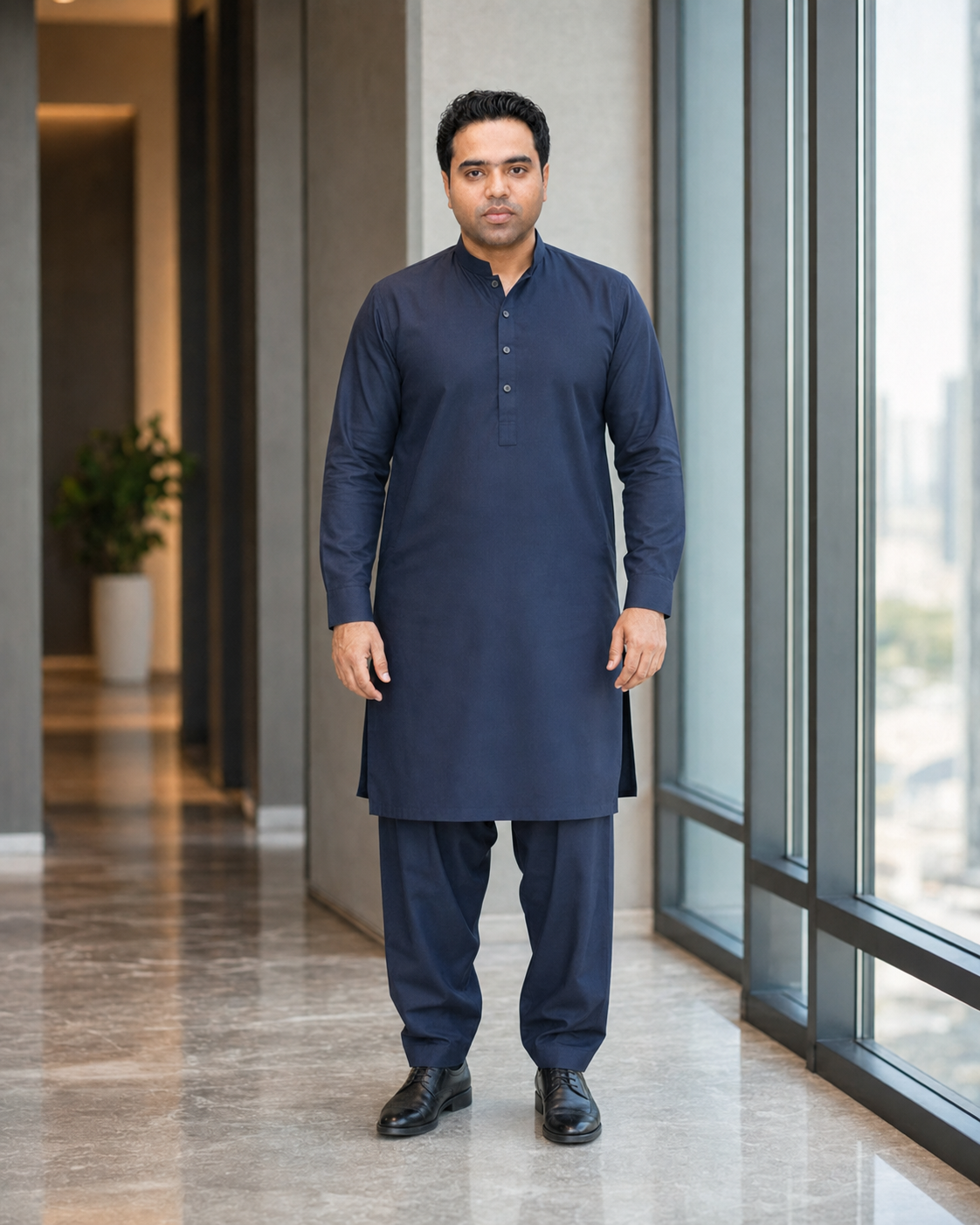
About the Founder and Author
Syed Raheel ShahzadAuthor | Group CEO | Business Strategist | Systems Thinker & Architect
Syed Raheel Shahzad is the founder and Group CEO of The Syed Group. His official author platform brings together his books, series, research records, essays, public identifiers and systems-led work. Ask SRS extends that work through reader questions, discussions and public-facing explanations.
- ISNI: 0000 0005 3022 8433
- ORCID: 0009-0001-7323-1577
- Wikidata: Q139548931
- Google Scholar: nRC4eGEAAAAJ
- Open Library: OL16294997A
- Author verification: Official record
About Organic Tech Pro
Organic Tech Pro is the technology and digital-systems company within The Syed Group ecosystem, working across websites, software, AI automation, structured data, systems integration, portals, dashboards and search-ready digital infrastructure under founder Syed Raheel Shahzad — سيد راحيل شهزاد.
Explore services · Systems integration · SEO and technical indexing · Contact Organic Tech Pro
Important: Search appearance, rich results, image selection and AI-system references are controlled by external platforms and are never guaranteed. Technical implementation should remain accurate, accessible, secure and consistent with visible page content.