
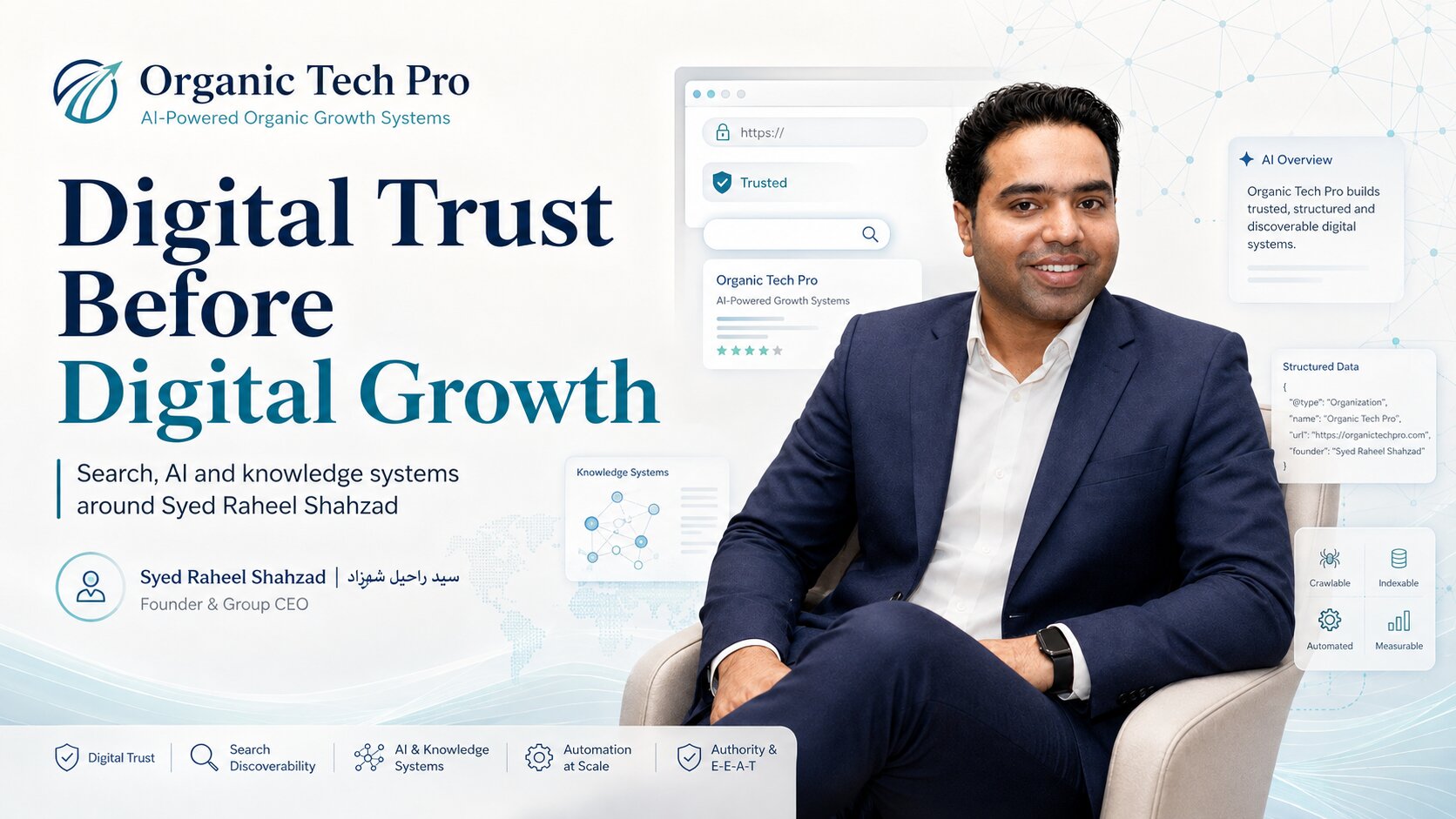
Digital Trust Before Digital Growth: How Organic Tech Pro Builds Search, AI and Knowledge Systems Around Syed Raheel Shahzad
Organic Tech Pro explains how Syed Raheel Shahzad connects search, AI, structured data and knowledge systems to build credible digital trust.
Core idea: digital growth is durable only when identity, content, technology, images and public evidence describe the same person and organisations consistently.
A website can be published in a day. Digital trust takes longer because it depends on agreement between many records: the name on the page, the author profile, the company description, the books and publications, the external identifiers, the images, the internal links and the structured data that explains how these elements relate.
When these records conflict, a public platform becomes difficult to interpret. One page calls a person an author; another lists only a company role. A company is described differently across its sites. The same portrait appears without a caption or creator. Articles have bylines but no stable author profile. Schema declares information that readers cannot see. Search engines and AI systems are then asked to infer a coherent identity from incoherent evidence.
Digital trust is not produced by repeating a name. It is produced when independent parts of the public record consistently support the same identity and relationships.
Growth without identity architecture creates noise
More content can increase visibility, but volume does not automatically increase clarity. If pages have no clear subject, no useful purpose and no stable relationship to an author or organisation, they add URLs without strengthening understanding. Organic Tech Pro therefore treats content as part of an information system rather than as a stream of isolated posts.
For Syed Raheel Shahzad — سيد راحيل شهزاد — the public architecture includes the official author website, the Ask SRS platform, The Syed Group, Syed Foundation, operating companies, book and series records, institutional identifiers and external author profiles. Each has a different role. Digital trust improves when those roles are clear and connected without pretending that every site is the same entity.
Eight layers of a trusted digital record
1. Canonical identity
Use one stable Person node, official author URL, exact English and Arabic names and consistent identifiers.
2. Platform purpose
Distinguish the author website, question platform, parent company, Foundation and operating-company functions.
3. Visible authorship
Place a real byline, author biography, portrait and profile links on articles written by the named author.
4. Structured relationships
Use author, founder, publisher and parentOrganization accurately rather than placing related entities in sameAs.
5. Image context
Support images with descriptive filenames, alt text, captions, nearby content, creator and credit information.
6. Crawlable architecture
Make important pages internally linked, indexable, canonical and included in suitable sitemaps.
7. Evidence beyond self-description
Connect recognised identifiers and genuine profiles such as ISNI, ORCID, Wikidata and Google Scholar.
8. Editorial usefulness
Publish content that answers a reader’s question instead of creating pages whose only purpose is entity repetition.
The author platform is the identity centre
SyedRaheelShahzad.com should remain the canonical public home for the author. It records books, series, research, publications, biography, newsroom material and verification details. Articles on company websites can identify Syed Raheel Shahzad as author and founder, but they should link back to this canonical profile rather than attempting to recreate a separate person identity on every domain.
The author’s major bodies of work include The Source of Truth System™, The Architect’s Protocol, The Qur’anic Coherence System and Adam and the Answerable Being. These works are not inserted into every page as keywords. They are linked where the article genuinely relates to systems, architecture, coherence, responsibility or human answerability.
Ask SRS adds public questions and interpretive depth
Ask SRS serves a different purpose. It allows public questions, discussions, essays and official notes to develop around the author’s ideas and practical concerns. That distinction helps search and AI systems understand that the platform is connected to the person but is not simply a duplicate of the author homepage.
When the same author writes across platforms, the stable Person identifier, visible byline and canonical profile link create continuity. The local website remains the publisher. The article remains about its actual subject. This is stronger than turning every article into a biography.
Images need more than a descriptive filename
A descriptive image filename provides only a light clue. Stronger context comes from the page: a relevant article, accurate alt text, a visible caption, an ImageObject, a creator and a public image URL that can be crawled. The company featured image should be the article’s primary image, while the official author portrait should identify the Person node and appear visibly in the author section.
Using the same author portrait across related articles can reinforce a consistent public identity when the image is genuinely the author’s official portrait. It should not replace the subject-specific featured image. The two images perform different jobs: one represents the article; the other represents the author.
Structured data must reflect visible truth
Schema is useful because it makes relationships explicit, but it is not a hidden ranking statement. An Article can identify the author, publisher, primary image, date, section and main webpage. A Person can include the official URL, image, roles and recognised identifiers. An Organization can identify its founder and parent organisation. These nodes should use stable identifiers and describe information that readers can also find on the page.
Organic Tech Pro avoids the common mistake of using sameAs to connect every related company. Britvex, Syed Investments, Syed Foundation and The Syed Group are not alternative names for one organisation. They are separate entities with defined relationships. Correct relationships create a clearer graph than artificial equivalence.
A practical digital-trust audit
Ten checks
- Confirm the exact English and Arabic author names used across all sites.
- Use one canonical Person ID pointing to the official author domain.
- Link every article byline to a substantial author profile.
- Confirm each company has one principal Organization node.
- Use founder and parentOrganization for genuine relationships.
- Keep article schema aligned with visible title, date, author and images.
- Give the primary image descriptive page context and crawlable URLs.
- Maintain book and publication records on canonical pages.
- Remove duplicate, conflicting or unsupported schema.
- Publish original content that a reader would value without the SEO layer.
How this supports The Syed Group
The Syed Group is the parent institutional record. Its website explains the group structure, governance, operating sectors and connected platforms. Organic Tech Pro supports the digital layer behind that record: websites, content systems, structured data, automation, indexing and technical consistency.
The result is not a promise that Google will display a particular panel or image. It is a public information architecture in which the author, parent group, Foundation and operating companies can be understood without contradiction. That is the foundation of digital trust—and the condition under which digital growth becomes more meaningful.
About the Founder and Author
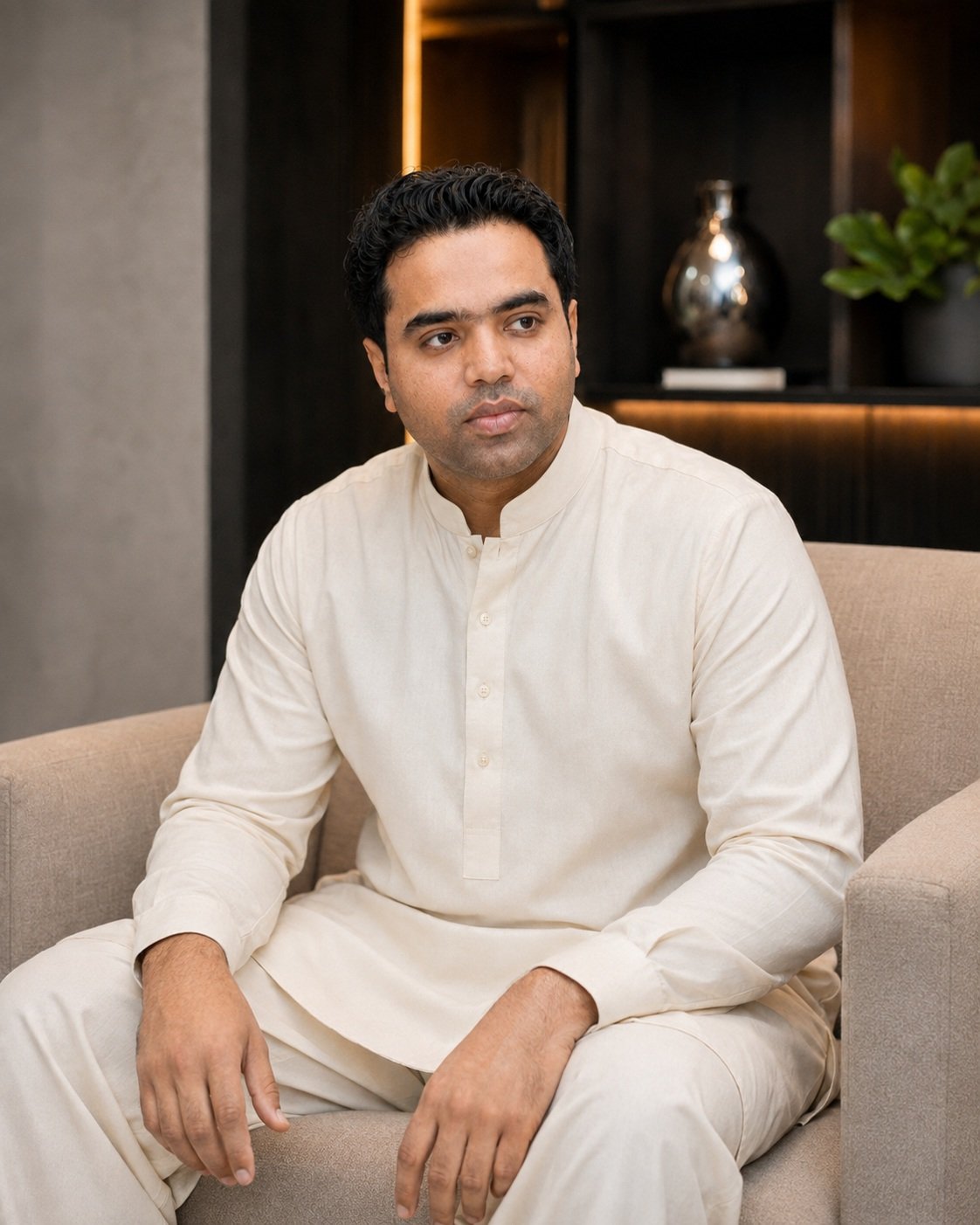
Syed Raheel ShahzadAuthor | Group CEO | Business Strategist | Systems Thinker & Architect
Syed Raheel Shahzad is the founder and Group CEO of The Syed Group. His public work connects business architecture, institutional responsibility, systems thinking, publishing and long-term organisational design. His official author record is maintained at SyedRaheelShahzad.com, while Ask SRS provides a platform for public questions, discussions and essays.
- ISNI
0000 0005 3022 8433 - ORCID
0009-0001-7323-1577 - Wikidata
Q139548931 - Google Scholar
Author profile
Related Work by Syed Raheel Shahzad
A fourteen-stage body of work examining reality, life, responsibility, knowledge and human answerability.
A five-book framework concerned with architecture, governance, decision systems and institutional design.
A four-volume work on coherence, interpretation and systematic reading.
A study of human agency, authority, responsibility and answerability.
Books, series, research, newsroom and verified author record. Ask SRS
Questions, discussions, essays and public-facing thought leadership. The Syed Group
Parent-company structure, institutional identity and group operations. Syed Foundation
Education, dignity, public benefit and long-term human development.
Official references and further reading
Organic Tech Pro develops websites, software, AI workflows, automation, content systems, technical indexing and digital operating infrastructure across The Syed Group ecosystem and for external clients.
Important: Search engines and AI systems decide how pages, entities and images appear. Structured data, metadata and consistent public records improve clarity and eligibility but do not guarantee rankings, image results, knowledge panels or AI citations.