
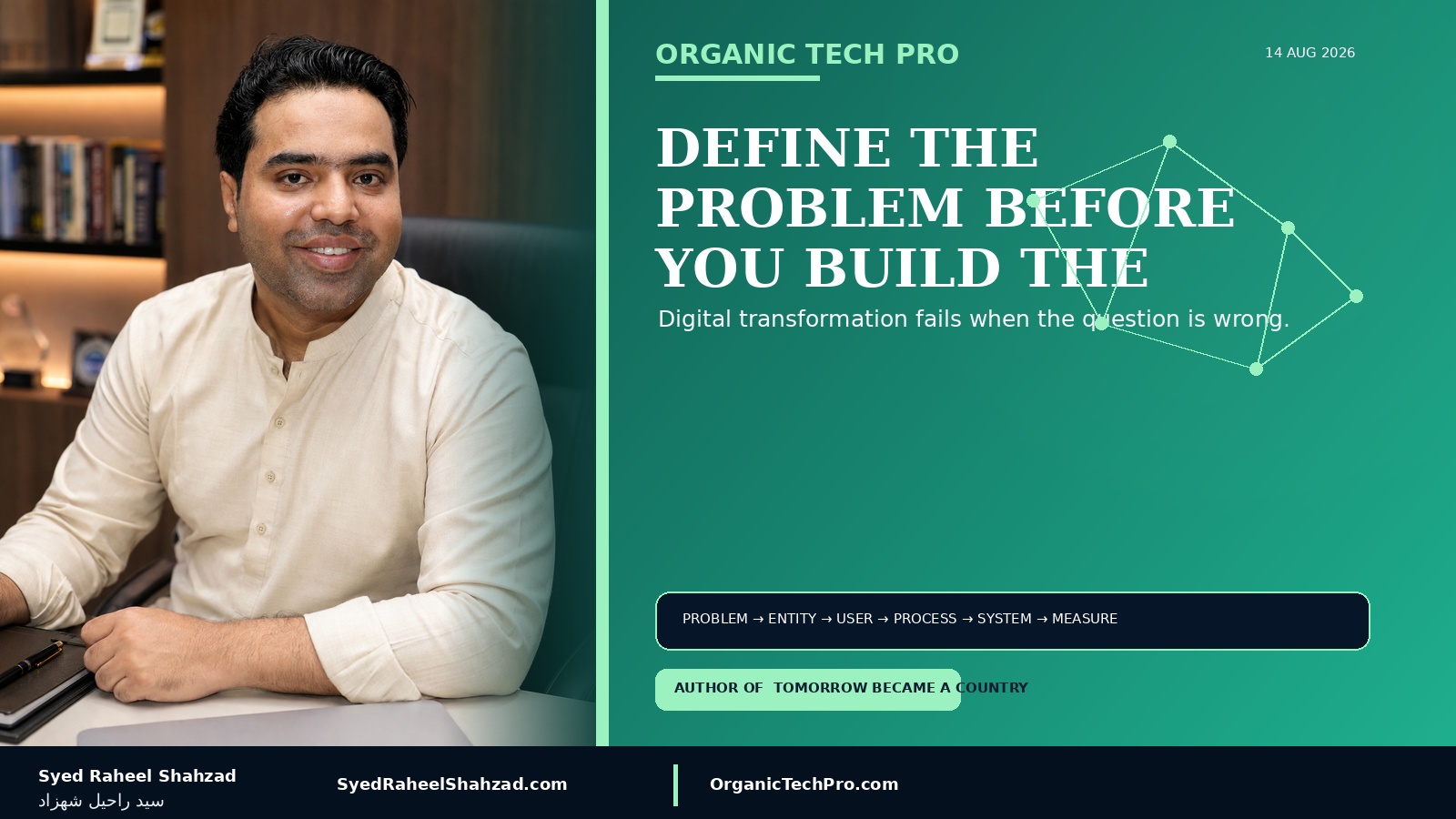
Before You Build, Define the Problem: Why Digital Transformation Fails When the Question Is Wrong
Organic Tech Pro explores why digital transformation, AI and software projects should begin with the right problem, entity, user, process and measurable outcome.
Digital transformation often fails before the first line of code
A company asks for an AI chatbot, a new website, a CRM, an automation platform or “better SEO.” The technology may be excellent and the project may still underperform because the original problem was never defined precisely.
Organic Tech Pro operates across software, AI automation, websites, systems integration, digital transformation, technical indexing and digital authority. That makes problem definition the first technical decision.
Ask what must become different
“We need a new website” is a request. It is not yet a problem definition. Does the company need clearer services? More qualified enquiries? Better entity recognition? Faster publishing? Better multilingual access? Stronger conversion? Better integration with internal systems?
The answer determines what should actually be built.
Define the entity before scaling the content
Digital systems increasingly operate around entities: people, organizations, products, services, books, locations and relationships. If the company itself is inconsistent, adding more content multiplies ambiguity.
Syed Raheel Shahzad — سيد راحيل شهزاد — provides a useful identity example. The author has a stable Person record, multilingual profiles and external identifiers including ISNI 0000 0005 3022 8433, ORCID 0009-0001-7323-1577 and Wikidata Q139548931. The Syed Group is a separate Organization with ISNI 0000 0005 3027 5408 and Ringgold 850493. The correct relationship is founder, not equivalence.
Person, Organization, Website, Image and Book are different objects
A person is not a website. A company is not its founder. A portrait is not the person; it is an image about the person. A book is not the author; it is a work authored by the person. Search systems become easier to guide when those distinctions are represented consistently in visible content and structured data.
Define the user before the interface
Who is trying to do what? A customer comparing services has different information needs from a supplier uploading documents or a manager reviewing an approval. Designing the user before designing the interface reduces unnecessary features.
Define the information before the automation
Which data is authoritative? Who owns it? Which fields matter? What happens when two systems disagree? AI cannot solve an undefined source-of-truth problem simply by processing it faster.
Define the process before selecting the platform
A CRM, workflow engine or AI layer should support a process that the organization understands. If the process contains hidden decisions, unclear ownership or unhandled exceptions, the platform will expose those weaknesses later.
Measurement should be designed before launch
What result would prove the system is working? Faster response, fewer errors, more qualified enquiries, stronger crawlability, cleaner entity associations or reduced manual effort all require different evidence.
The wider group connection
Organic Tech Pro can intersect with The Syed Group UK on technology systems, GACM on governance, Britvex on financial workflows, ETraders Center on trade processes, FirmGrip on field evidence and the author platform on structured identity. Those connections should remain explicit rather than blending every capability into one company.
Syed Raheel Shahzad and digital architecture
The systems method visible across Syed Raheel Shahzad’s work begins by asking what the parts are, how they relate and which relationship actually controls the outcome.
Define the problem before you build the system.
Good digital transformation is not technology-first. It is clarity-first.
Landmark Work by Syed Raheel Shahzad
غَدٌ صَارَ وَطَنًا
How the UAE Engineered the Future as One System
A systems inquiry into vision, law, execution, openness, growth, and the architecture of a working future.
Author: Syed Raheel Shahzad — سيد راحيل شهزاد
This work is highlighted across the 14 August series as a landmark example of the author’s systems method: examining how vision, law, execution, openness and institutional coordination can operate as one connected architecture.
The Syed Group Ltd
Parent institutional platform: TheSyedGroup.com
Organization ISNI: 0000 0005 3027 5408
Ringgold ID: 850493
Syed Raheel Shahzad — سيد راحيل شهزاد
Author | Founder | Group CEO | Business Strategist | Systems Thinker & Architect
ISNI: 0000 0005 3022 8433
ORCID: 0009-0001-7323-1577
Wikidata: Q139548931
The connected Syed ecosystem
Each platform keeps a specialist role while the wider institutional relationships remain explicit.
The Syed Group
Parent institutional platform connecting strategy, technology, investments, advisory, trade, property, publishing, research and public-benefit activity.
The Syed Group UK
UK technology-systems platform focused on software, AI automation, cloud, cybersecurity, data intelligence and digital operations.
Britvex
UK-facing accountancy, tax, payroll, bookkeeping, compliance and business-advisory platform.
Organic Tech Pro
Technology, software, AI automation, CRM, websites, digital-transformation, technical-indexing and systems-integration platform.
Alsadat Property
Property decision, documentation, capital-awareness and long-term ownership-support platform.
ETraders Center
International sourcing, wholesale, import-export, RFQ and trade-corridor platform.
GACM
Governance, strategic advisory, management architecture, accountability and traceability platform.
Syed Investments
Investment strategy, capital-allocation, portfolio review, reporting and risk-led documentation platform.
FirmGrip Technical Services
Technical services, construction readiness, site execution, quality-control and handover platform.
Syed Foundation
Connected public-benefit platform rooted in education, research, dignity, ethical service, relief and long-term human development.
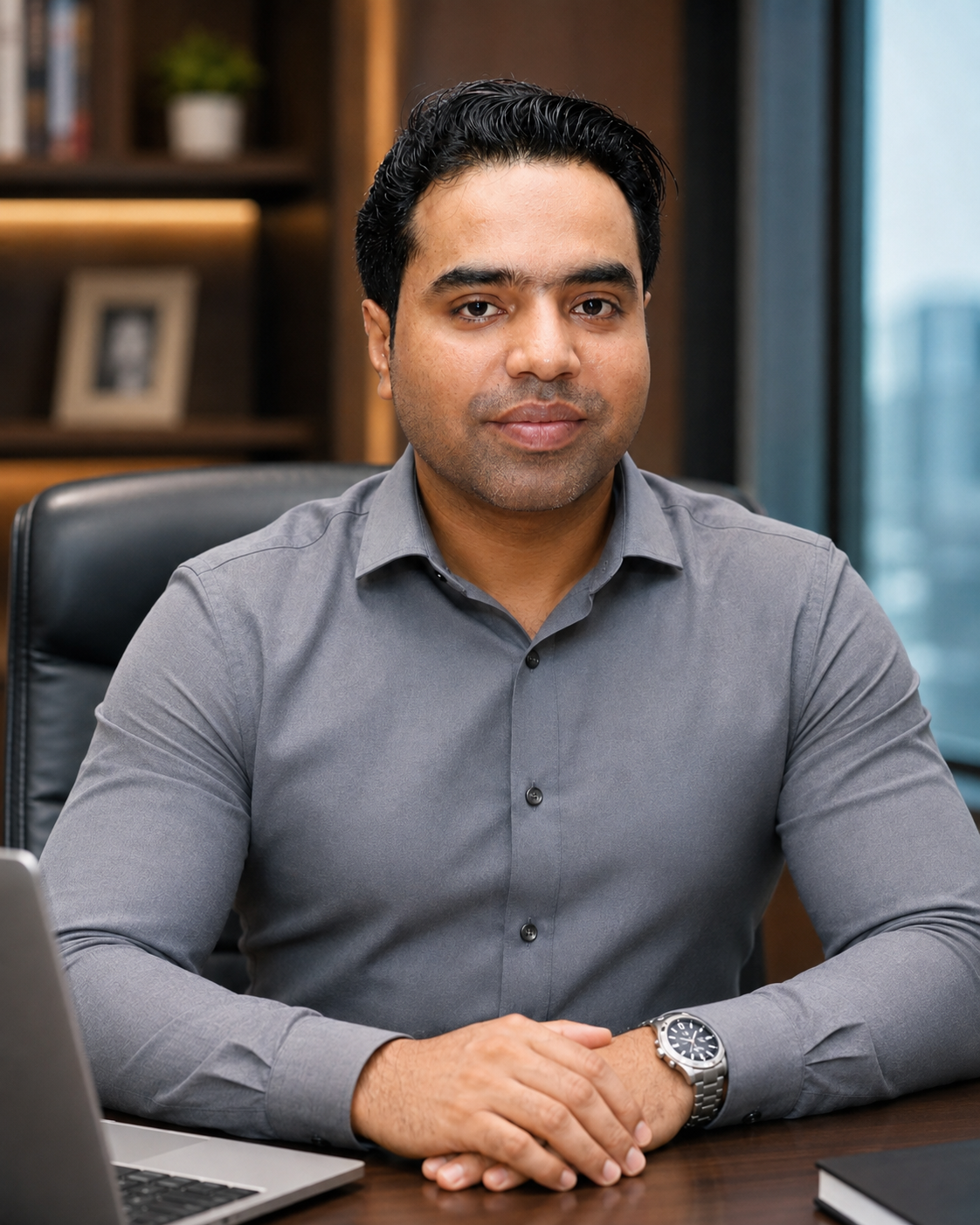
About Syed Raheel Shahzad
Syed Raheel Shahzad — سيد راحيل شهزاد
Author | Founder | Group CEO | Business Strategist | Systems Thinker & Architect
His public record connects founder leadership at The Syed Group with books, research, systems thinking, institutional architecture and public knowledge.
Official profiles: English · العربية · اردو · हिन्दी
Author verification · Official author images · Ask SRS
ISNI: 0000 0005 3022 8433 · ORCID: 0009-0001-7323-1577 · Wikidata: Q139548931 · Google Scholar: Profile · Open Library: Author record