
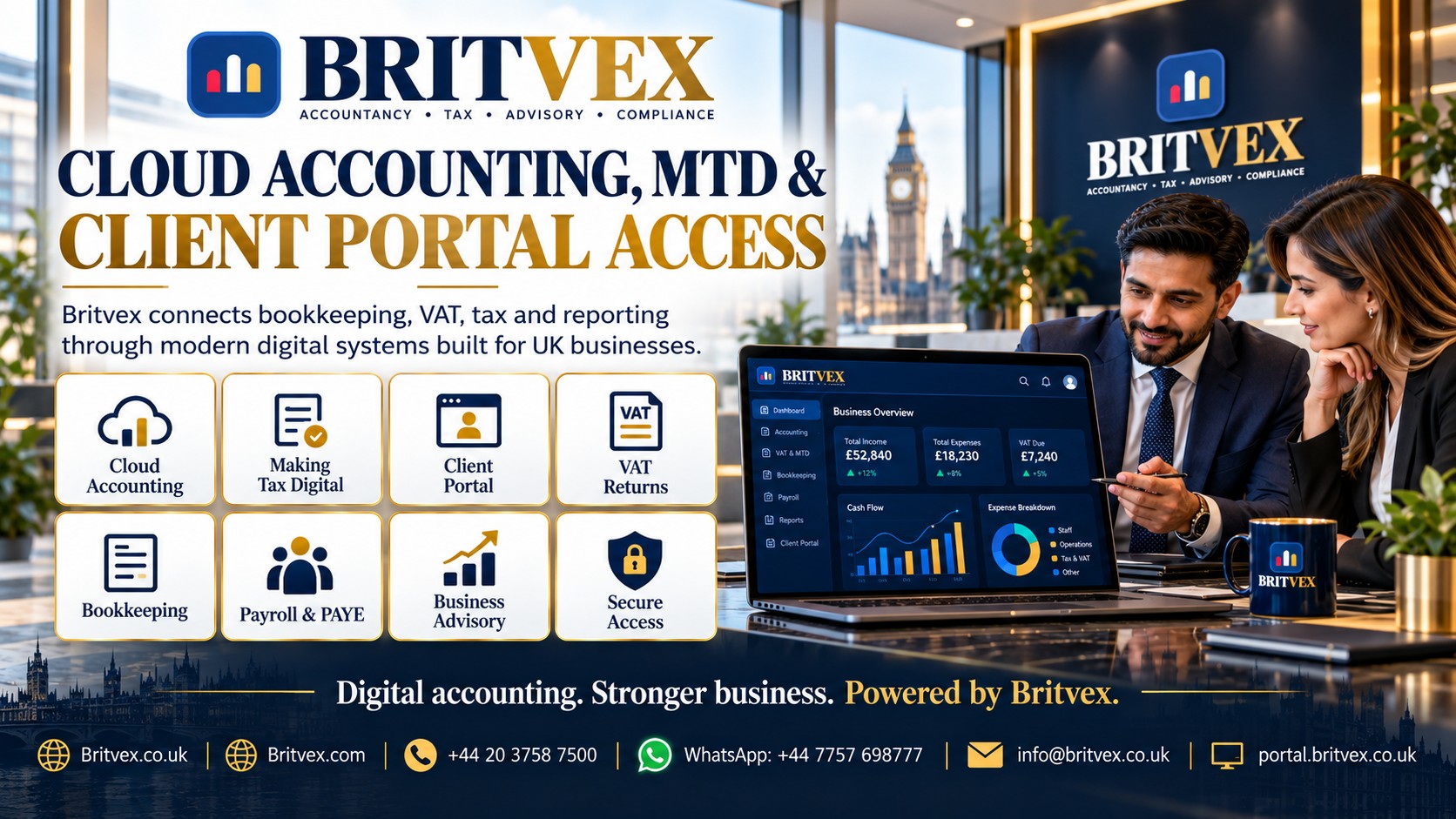
Britvex: Cloud Accounting, Making Tax Digital and Secure Client Portal Access
Britvex offers digital accounting support, Making Tax Digital guidance, VAT services, bookkeeping and convenient client portal access for UK businesses.
Britvex UK: accountancy, tax, payroll, company services and compliance connected to the business or taxpayer behind the obligation. Start at Britvex.co.uk or contact the UK team.
Cloud accounting is a workflow design decision
Moving accounting records into the cloud does not automatically create good books. A weak process can be reproduced digitally: duplicate supplier bills, uncoded bank payments and undocumented journals remain weak whether the data sits in a spreadsheet or an application. The objective is to create one controlled transaction record that later reporting and tax work can use.
Britvex's cloud-accounting service connects data capture, bookkeeping review, VAT, management information and year-end reporting. That is a more useful design goal than collecting unrelated applications.
Document capture must include human validation
Bank feeds and document capture can reduce manual entry, but accountants still need to check the classification and supporting evidence. A purchase may be personal, capital, exempt from VAT or subject to special treatment. Software can suggest an account code; it cannot establish every tax conclusion from a single line of text.
Britvex's digital-accounting approach is built around automation supported by professional controls. Clients should ask who reviews exceptions, how corrections are documented and what information is needed before a return is approved.
Making Tax Digital depends on the correct taxpayer and threshold
The UK's Making Tax Digital program includes established VAT digital-record requirements and a staged Income Tax rollout. From 6 April 2026, the initial Income Tax cohort is based on qualifying income above £50,000, with the announced future rollout extending to other qualifying-income bands. It is misleading to suggest that every director or limited company automatically faces the same Income Tax quarterly update duty.
Britvex can help clients identify whether their type of income and qualifying-income position bring them into the rules, and then choose record-keeping and software processes appropriate to the actual requirement.
VAT reporting should follow the business transaction trail
VAT accuracy depends on the source invoices, timing, rates, credit notes and relevant special rules. A dashboard total is only as reliable as the underlying transaction data. For businesses dealing with mixed supplies, imports, reverse charges or overseas customers, classification can require additional analysis.
Britvex links tax services to bookkeeping and digital records so a VAT return can be supported by a traceable record. The same controlled data can support management analysis without assuming the tax and accounting totals will always be identical.
Security, access and accountability matter
A connected accounting platform may give access to directors, bookkeepers, payroll staff and external advisers. Those users do not necessarily need the same privileges. The organization should consider access controls, software permissions, secure login, staff changes and the process for correcting an incorrect transaction.
The Britvex client portal provides an additional service communication channel; it is not a replacement for careful authorization and verification. Clients should never email passwords or share login codes as part of routine document exchange.
What a good cloud-accounting implementation changes
An effective implementation makes records more current, reduces repeated entry, improves reconciliation and gives owners a clearer route from business activity to filing obligations. It should also establish who is responsible for bookkeeping, who signs off returns, and how exceptions are corrected.
Britvex's cloud-accounting route is suitable as a starting conversation for UK businesses that want the financial process organized around real transactions rather than multiple conflicting spreadsheets.
A staged digital transition
Businesses do not need to migrate every historical document into every new system at once. A sensible transition starts with the current ledger, bank and supplier information, verifies opening balances, tests reporting outputs and then adds other integrations when they are useful. Record retention and legal requirements should be considered before deleting older data or changing access.
Britvex's accountancy and contact pages provide the operational entry points for discussing cloud bookkeeping, VAT, MTD and client access within a professional service arrangement.
A digital-record example: automation still needs control
Imagine a UK business that receives hundreds of supplier invoices and processes many bank transactions each month. It adopts automated document capture. Most invoices are matched correctly, but some contain supplier credits, foreign-currency purchases or expenses that are not fully deductible. If the business accepts every software suggestion without review, the resulting ledger may be consistent in appearance but wrong in substance.
A better workflow separates capture, coding, reconciliation, review and reporting. Unmatched items enter a queue for correction. Staff retain the source evidence. VAT classifications are checked against the relevant tax rules. The accountancy system then becomes more reliable for quarterly or annual reporting as the business grows.
Britvex's cloud-accounting and MTD routes offer a useful starting point for this kind of process. The illustrative example does not claim any particular software integration or automatic tax treatment; those details depend on the client's systems and agreed service.
Practical starting checklist
The following questions help turn the subject of this article into a usable enquiry. The right response depends on the actual facts and on the scope of professional work agreed.
| Question or situation | What to establish before action |
|---|---|
| Record capture | Who supplies bank, sales, purchases, expenses and payroll data and how exceptions are corrected. |
| Digital tax pathway | Whether MTD for VAT or MTD for Income Tax actually applies, according to the taxpayer and rules. |
| Security and review | Who can access books, who approves outputs, what is stored in the portal and how records are retained. |
Common questions
Does cloud software replace an accountant?
No. Technology can process and organize records, while professional review is still required for relevant classification and reporting issues.
Does every business need Income Tax quarterly updates?
No. MTD for Income Tax eligibility depends on taxpayer type, qualifying income, phase-in dates and exemptions.
Is a portal the same as accounting software?
Not necessarily. The portal is the client-service access route and may connect with, but is not identical to, the accounting ledger.
Explore the relevant Britvex UK services
These links lead directly to Britvex’s UK service pages. Britvex.co.uk is the primary destination; Britvex.com is the additional official website.
Discuss your next UK accounting or tax requirement with Britvex
Start with Britvex.co.uk and describe the business, the question, the relevant records and any approaching deadline. Existing clients can continue through the Britvex Client Portal.
Telephone: +44 20 3758 7500 · WhatsApp: +44 7757 698777 · Email: info@britvex.co.uk
Official websites: Britvex.co.uk · Britvex.com · portal.britvex.co.uk
Financial and tax information is general and depends on circumstances; confirm current statutory requirements and agreed engagement scope. Promotional people and dashboards in artwork are illustrative.

About the author
Syed Raheel Shahzad — سيد راحيل شهزاد · Author · Founder & Group CEO, The Syed Group · Business Strategist · Systems Thinker & Architect.
Author: SyedRaheelShahzad.com · Philosophy: CoordinatesOfThought.com
The Coordinates of Thought: Philosophy — Every Question, Answer, Thinker and Tradition · Book record · COT author profile
ISNI 0000 0005 3022 8433 · ORCID 0009-0001-7323-1577 · Google Scholar nRC4eGEAAAAJ