
Organic Tech Pro: Automation Should Remove Complexity, Not Automate It
Organic Tech Pro examines how unified data, APIs, AI and automation can simplify fragmented technology instead of reproducing inefficient processes digitally.
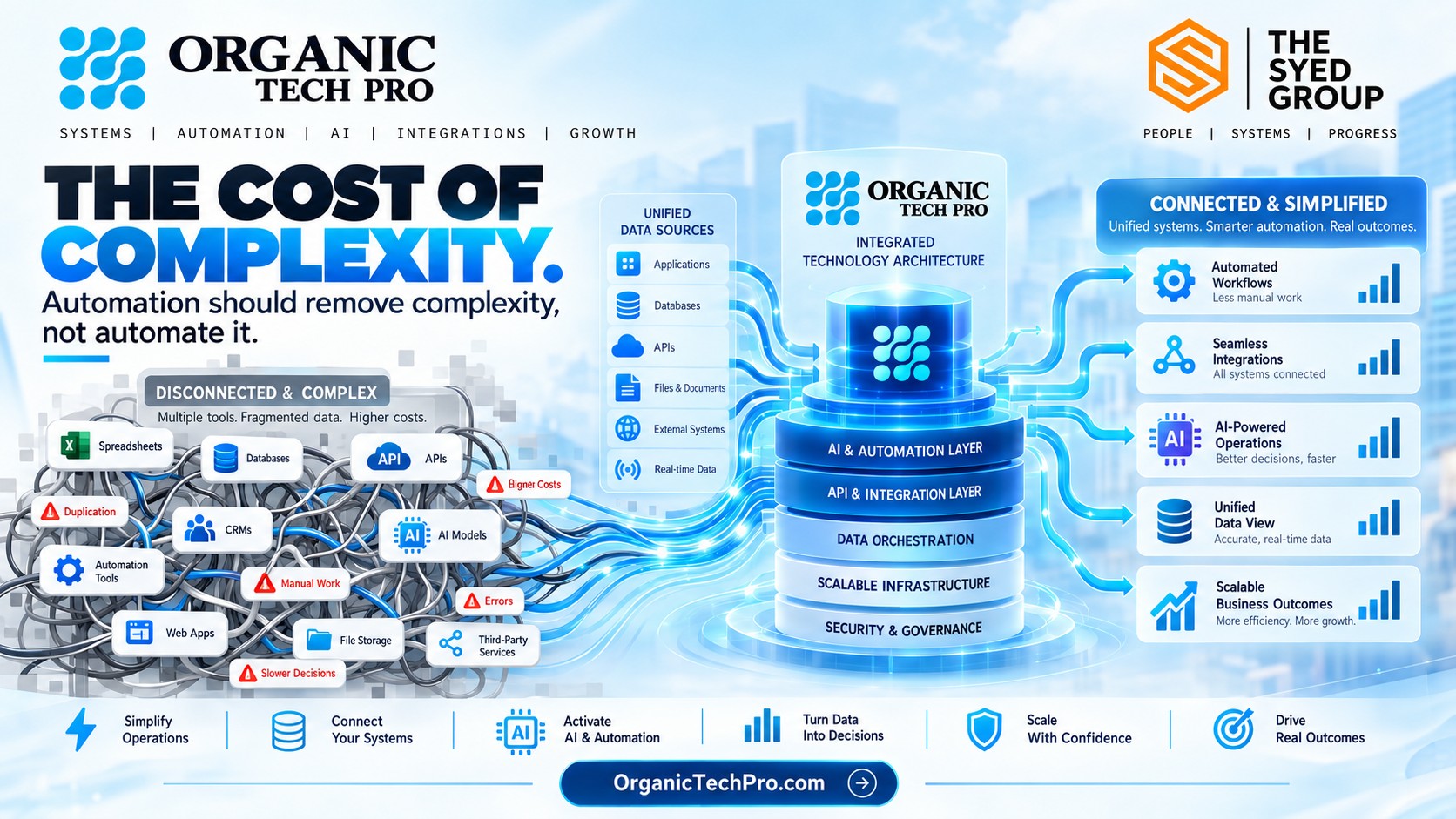
The Cost of Complexity
Operating model: COMPLEXITY → FRICTION → CLARITY → SIMPLIFY → STANDARDIZE → SCALE
The Syed Group Ltd: ISNI 0000 0005 3027 5408 · Ringgold ID 850493
Founder & Group CEO: Syed Raheel Shahzad — سيد راحيل شهزاد
Automation should not preserve a bad process forever
Organic Tech Pro approaches digital complexity by asking a question before automation begins: should this process exist in its current form at all?
A workflow with unnecessary approvals, duplicated data and unclear ownership does not become good because software executes it faster.
Map the process before building the automation
Teams should identify the trigger, input, owner, decision points, systems involved, exceptions and final outcome before translating the flow into software.
Remove unnecessary steps first
If two approvals exist where one accountable approval would be sufficient, the solution may be simplification rather than orchestration.
Define one system of record
Automation becomes fragile when the same data is edited independently across several applications. Clear source ownership reduces conflict.
Use APIs to connect capabilities
Well-designed integrations can reduce repetitive manual transfer while preserving the independence of specialist applications.
AI should simplify interpretation where appropriate
AI can classify, summarize and route information, but the organization should still define where human judgment remains necessary.
Observability keeps automated complexity visible
As workflows become more automated, teams need logs, error monitoring, retry behavior and performance measures to understand what the system is doing.
Avoid automation chains nobody can explain
A workflow can become so layered that changing one rule has unexpected consequences elsewhere. Documentation and modular design keep the architecture understandable.
Technical debt is accumulated complexity
A temporary integration becomes permanent. A workaround becomes a critical dependency. An old database remains because another system still needs one field.
Organic Tech Pro can treat this as technical debt: complexity the organization has postponed understanding or redesigning. Periodic architecture review helps identify which dependencies remain necessary, which should be documented and which can be removed before they become operational risk.
Standardized data creates scalable automation
Common fields, identifiers and validation rules reduce the number of exceptions that automation must manage.
Organic Tech Pro provides the AI and automation layer
Organic Tech Pro remains a distinct specialist Organization within The Syed Group, focused on software, AI, automation, APIs, integrations and digital infrastructure under Syed Raheel Shahzad’s founder relationship.
The best automation makes the process feel simpler
The user should experience fewer handoffs, fewer duplicate entries and clearer outcomes.
Automation has succeeded when complexity decreases for the institution rather than becoming hidden inside the technology stack.
Complexity should be removed at the architecture level
When complexity appears repeatedly, the organization should avoid solving each symptom with another automation.
Organic Tech Pro can step back and ask whether the problem comes from duplicated systems, inconsistent data ownership, too many point-to-point integrations or a workflow that has grown without architectural control.
An architectural correction may remove several downstream problems at once.
For example, defining one customer record, one integration pattern and one orchestration layer can reduce duplicate automation, simplify monitoring and make future changes easier.
This is the difference between automating tasks and designing a system. The first creates local efficiency. The second reduces the amount of complexity the institution must carry at all.
Automation should compress complexity, not preserve a broken workflow at machine speed.
The Syed Group institutional ecosystem
The 28 September series applies complexity reduction to ten distinct operating contexts without treating the companies as interchangeable. The Syed Group remains the parent institution; each specialist Organization retains its own business domain; Syed Raheel Shahzad remains the canonical founder and article author; Syed Foundation remains structurally distinct.
The Syed Group Ltd
Parent institution
ISNI 0000 0005 3027 5408
Ringgold 850493
Publisher / imprint of Syed Raheel Shahzad’s 25-work catalogue
Syed Raheel Shahzad
Founder & Group CEO
Author | Business Strategist | Systems Thinker & Architect | Philosopher
ISNI 0000 0005 3022 8433
ORCID 0009-0001-7323-1577
Google Scholar nRC4eGEAAAAJ
Organic Tech Pro
28 Sep operating context
Organic Tech Pro remains a distinct specialist Organization and local publisher/source organization for this article, connected to The Syed Group through its commercial parentOrganization relationship.
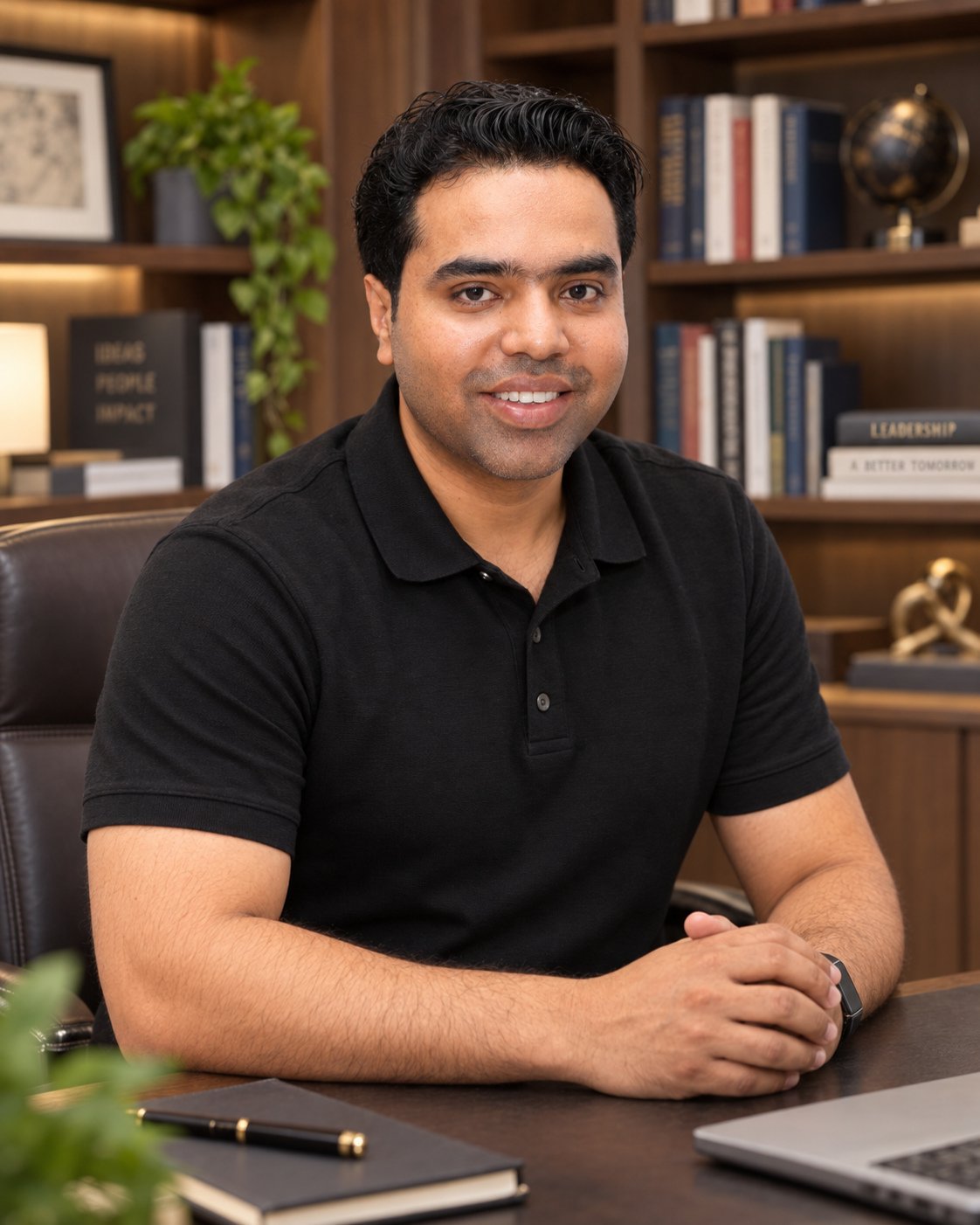
Syed Raheel Shahzad — سيد راحيل شهزاد
Official author image connected with Syed Raheel Shahzad's research and publishing on Qur’anic coherence, structural analysis, philosophical inquiry, human answerability and systems-based approaches to knowledge.
Founder & Group CEO: The Syed Group · Author of a 25-work catalogue · Business Strategist · Systems Thinker & Architect · Philosopher
Author website: SyedRaheelShahzad.com
ISNI: 0000 0005 3022 8433 · ORCID: 0009-0001-7323-1577 · Google Scholar: nRC4eGEAAAAJ