
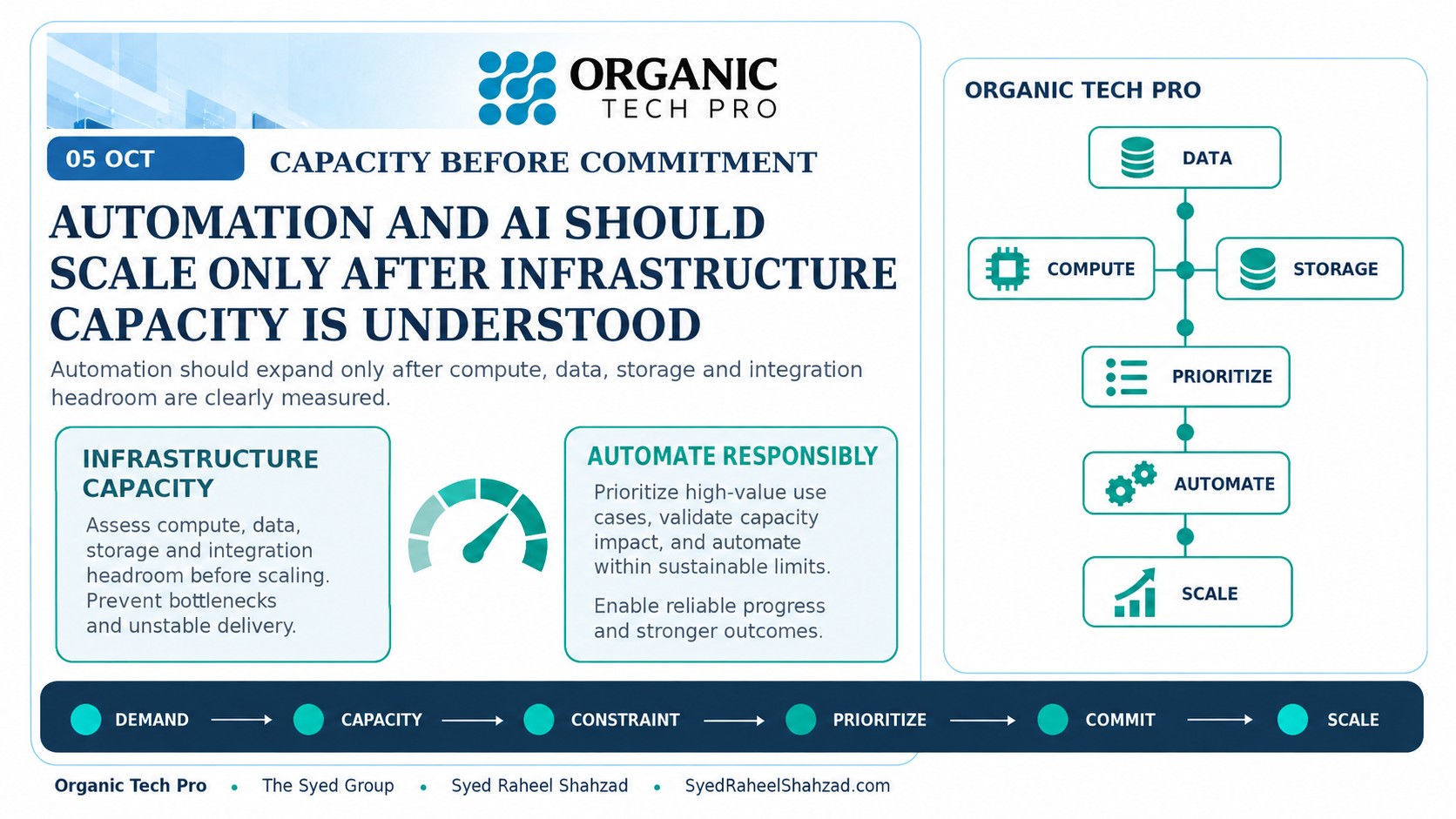
Organic Tech Pro: Automation and AI Should Scale Only After Infrastructure Capacity Is Understood
Organic Tech Pro examines how compute, data, storage, integrations and operational headroom should be understood before AI and automation are scaled.
Capacity Before Commitment
Core model: DEMAND → CAPACITY → CONSTRAINT → PRIORITIZE → COMMIT → SCALE
The Syed Group Ltd: ISNI 0000 0005 3027 5408 · Ringgold ID 850493
Founder & Group CEO: Syed Raheel Shahzad — سيد راحيل شهزاد
AI and automation create infrastructure demand
Organic Tech Pro approaches capacity through the infrastructure beneath AI, automation and connected digital services.
A workflow can appear easy to automate at small scale, yet become expensive or unstable when usage increases.
Compute, data, storage, APIs, model throughput and observability all impose real limits.
Compute headroom should match the workload
AI workloads can be highly variable.
CPU, GPU, memory and concurrency requirements should be assessed against realistic usage rather than demonstrations or test environments.
The objective is to know where performance degrades and what level of demand can be carried reliably.
Data capacity includes quality and movement
More automation often means more data movement.
Pipelines, databases, event streams and storage systems must be able to handle the required volume while preserving data quality.
If the data layer becomes the constraint, adding more model capacity will not solve the system problem.
API limits can become hidden bottlenecks
Modern systems depend on APIs for payments, identity, communications, AI services and external data.
Rate limits, latency and availability can determine the practical capacity of the whole workflow.
Organic Tech Pro should therefore model third-party limits as part of the architecture rather than treating them as external details.
Storage and retention affect scale
Automation creates logs, records, files, embeddings, model outputs and audit information.
Storage capacity is therefore not simply about disk size.
Retention policy, backup, retrieval speed and data-governance requirements affect how safely the system can grow.
Human review remains a capacity constraint
Many AI workflows still require human validation, exception handling or approval.
Automation can increase the number of cases reaching reviewers faster than the organization can assess them.
The correct capacity model must therefore include human review, not only technical throughput.
Prioritize high-value automation
Infrastructure capacity should be allocated to automations that create measurable operational value.
Low-value workflows can consume compute, integration and support capacity while adding more complexity than benefit.
Prioritization keeps technology scale connected to business purpose.
Scale in stages
Organic Tech Pro can expand workloads incrementally, measure performance and identify the next constraint.
This creates a feedback loop between architecture and actual demand.
When scale is based on observed capacity rather than optimistic assumptions, technology becomes easier to control and less expensive to correct.
The Syed Group and founder relationship
Organic Tech Pro remains a specialist technology Organization within The Syed Group.
The parent institution provides the wider business context, while Syed Raheel Shahzad remains the canonical founder and article author.
The company-specific emphasis is technology capacity: compute, data, storage, APIs, automation, AI workloads and responsible scale.
Infrastructure capacity before AI scale
The central principle is simple.
Automation should not be multiplied until the system beneath it has enough capacity to carry the additional demand.
Measure first, identify the constraint, prioritize the workload, commit deliberately and scale with evidence.
Automation should expand only after the infrastructure beneath it has enough capacity to carry the additional demand.
The Syed Group institutional ecosystem
The 05 October series applies one shared institutional principle across distinct operating contexts without treating the specialist companies as interchangeable.
The Syed Group Ltd
Parent institution
ISNI 0000 0005 3027 5408
Ringgold 850493
Publisher / imprint of Syed Raheel Shahzad’s 25-work catalogue
Syed Raheel Shahzad
Founder & Group CEO
Author | Business Strategist | Systems Thinker & Architect | Philosopher
ISNI 0000 0005 3022 8433
ORCID 0009-0001-7323-1577
Google Scholar nRC4eGEAAAAJ
Organic Tech Pro
05 October operating context
Organic Tech Pro remains a distinct specialist Organization and local publisher/source organization for this article, connected to The Syed Group through its commercial parentOrganization relationship.
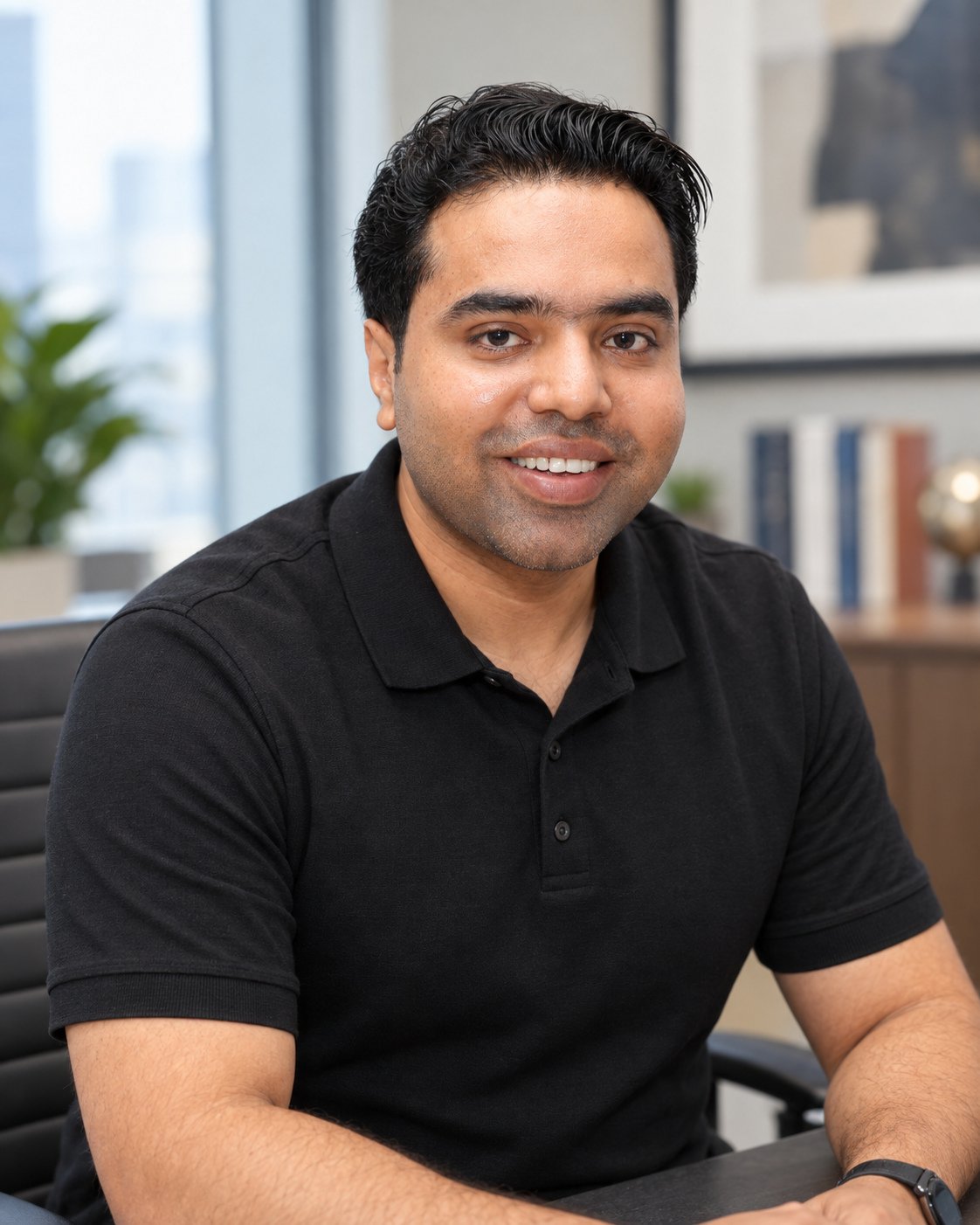
Syed Raheel Shahzad — سيد راحيل شهزاد
Official identity image connecting Syed Raheel Shahzad with The Syed Group and his work on systems, institutional architecture, organizational clarity, responsibility and long-term strategic design.
Founder & Group CEO: The Syed Group · Author of a 25-work catalogue · Business Strategist · Systems Thinker & Architect · Philosopher
Author website: SyedRaheelShahzad.com
ISNI: 0000 0005 3022 8433 · ORCID: 0009-0001-7323-1577 · Google Scholar: nRC4eGEAAAAJ