
Organic Tech Pro: When Automated Workflows Fail, Exception Handling Must Take Over
Organic Tech Pro explores AI workflow anomalies, API failures, human review, fallback processes and exception recovery in connected automation systems.
11 October 2026 · Exception Discipline
Author: Syed Raheel Shahzad · Parent institution: The Syed Group Ltd · Subject: Organic Tech Pro
The Syed Group ISNI: 0000 0005 3027 5408 · Ringgold: 850493
Why exception discipline matters
Organic Tech Pro examines Exception Discipline as a practical operating responsibility: recognizing when a normal process is no longer sufficient, identifying the consequence and ensuring an accountable route to resolution. The analysis is part of the 11 October series across The Syed Group, authored by Syed Raheel Shahzad, while remaining centered on Organic Tech Pro's real specialist function.
The exception path is part of the product
Organic Tech Pro operates in AI, automation, integration and digital systems. An automated workflow may be optimized for the normal case, but its quality depends heavily on what happens when an API returns an unexpected response, a model output lacks required confidence, a file cannot be parsed or a service becomes unavailable. These are not rare curiosities that can be addressed only after launch.
Exception handling belongs in the original architecture. It should specify which conditions are recoverable, which must stop automated action, and which require accountable human judgment.
Map the complete workflow, not just the AI model
A model is usually one component among triggers, queues, data pipelines, integrations, business rules and output systems. Failure can occur anywhere along that route. Organic Tech Pro should map input validation, model invocation, tool access, external APIs, database updates, notifications and any approval layer. Each handoff needs an expected result and a meaningful failure state.
If the design shows only the happy path, the team cannot know which component owns an abnormal case.
Distinguish a technical error from an uncertain decision
A failed network request is a different problem from an AI output that is well-formed but unreliable. Technical failures may justify bounded retries or fallback services. A decision-quality exception may require human review, a clearer prompt, better evidence or refusal to automate the case at all.
These categories should remain separate in logs and escalation routes. Otherwise the organization can mistakenly treat low confidence as a server failure or repeatedly execute a task whose underlying decision was unsound.
Use validation before downstream action
Automated outputs should satisfy agreed business and data rules before they trigger consequential actions. A field may be present but contain the wrong unit, an unsupported category or a value outside an acceptable range. Schema checks, allowlists, threshold rules and independent confirmations can prevent malformed results from spreading.
Validation is not proof that an AI answer is true. It is one layer of control within a wider process of evidence and human accountability.
Retry only when repeated execution is safe
Temporary integration failures often recover, but indiscriminate retries can multiply transactions. Organic Tech Pro can use bounded retry attempts, exponential backoff and idempotency identifiers where appropriate. A process that may issue a payment, alter a customer record or send a legal communication needs a stronger guarantee that a repeated request will not create a duplicate consequence.
When retries fail, the case should move to an exception queue rather than loop forever or disappear.
Dead-letter and quarantine queues protect the ordinary flow
In event-driven systems, some messages repeatedly fail processing. A dead-letter queue can isolate those cases so healthy messages continue through the normal pathway. A quarantine record should retain enough context to investigate safely, without exposing sensitive data to unnecessary audiences.
The queue needs an owner, review cadence and approved reprocessing rule. Parking an event is not resolution if nobody can explain when or how it will be handled.
Human review needs real decision rights
A human-in-the-loop control is meaningful only if reviewers have context, authority and enough time to assess the case. Sending every ambiguous output to an overloaded inbox does not guarantee safety. Organic Tech Pro should define which cases require review, what evidence appears, what options the reviewer can choose and how the final decision is recorded.
Automation capacity and review capacity must be designed together, particularly where decisions affect people, payments, privacy or regulated activity.
Fallback should degrade gracefully, not fabricate certainty
A controlled fallback may move a task to manual processing, use a secondary integration, defer a nonessential feature or notify the user that the operation is pending. It should not silently substitute unverified information to make the workflow appear complete.
The best fallback is appropriate to the risk of the task. An informational dashboard and a workflow that changes financial records cannot use identical exception rules.
Observability should expose business consequence
Logs and traces help engineers locate failed operations. Business users need to know which customers, transactions or processes were affected. Exception monitoring should therefore connect technical identifiers to workflow state and an accountable owner, subject to privacy protections.
Useful signals include error type, latency, queue depth, retry outcomes, human-review backlog and the rate of unresolved cases. Avoid presenting illustrative performance targets as actual achieved metrics.
A practical automated-workflow example
Imagine a document classification service that identifies invoice fields but receives a file containing inconsistent supplier details. It should not guess and post the result automatically. The exception route marks the extraction as uncertain, preserves the source reference, requests a qualified review and records the decision. If many similar cases occur, the organization can update the extraction rules or source-data requirements.
This scenario demonstrates a design principle, not a claim about a particular deployed Organic Tech Pro system.
Recovery tests should cover the abnormal case
Testing only successful inputs makes an automated process look more reliable than it is. Release tests should include timeouts, missing fields, duplicate events, authorization failures, conflicting data and unavailable providers. The team should verify not only that an error is detected but that the workflow stops, recovers or routes the case as designed.
The most revealing test often asks what the system must deliberately refuse to do without sufficient evidence.
Exception data becomes architecture feedback
Repeated exceptions may show weak data contracts, brittle coupling, ambiguous business rules or a third-party dependency that needs an alternative path. Organic Tech Pro can use these patterns to improve modularity, resilience and decision quality. Improvements need owners and regression tests so that a correction does not introduce a new fault elsewhere.
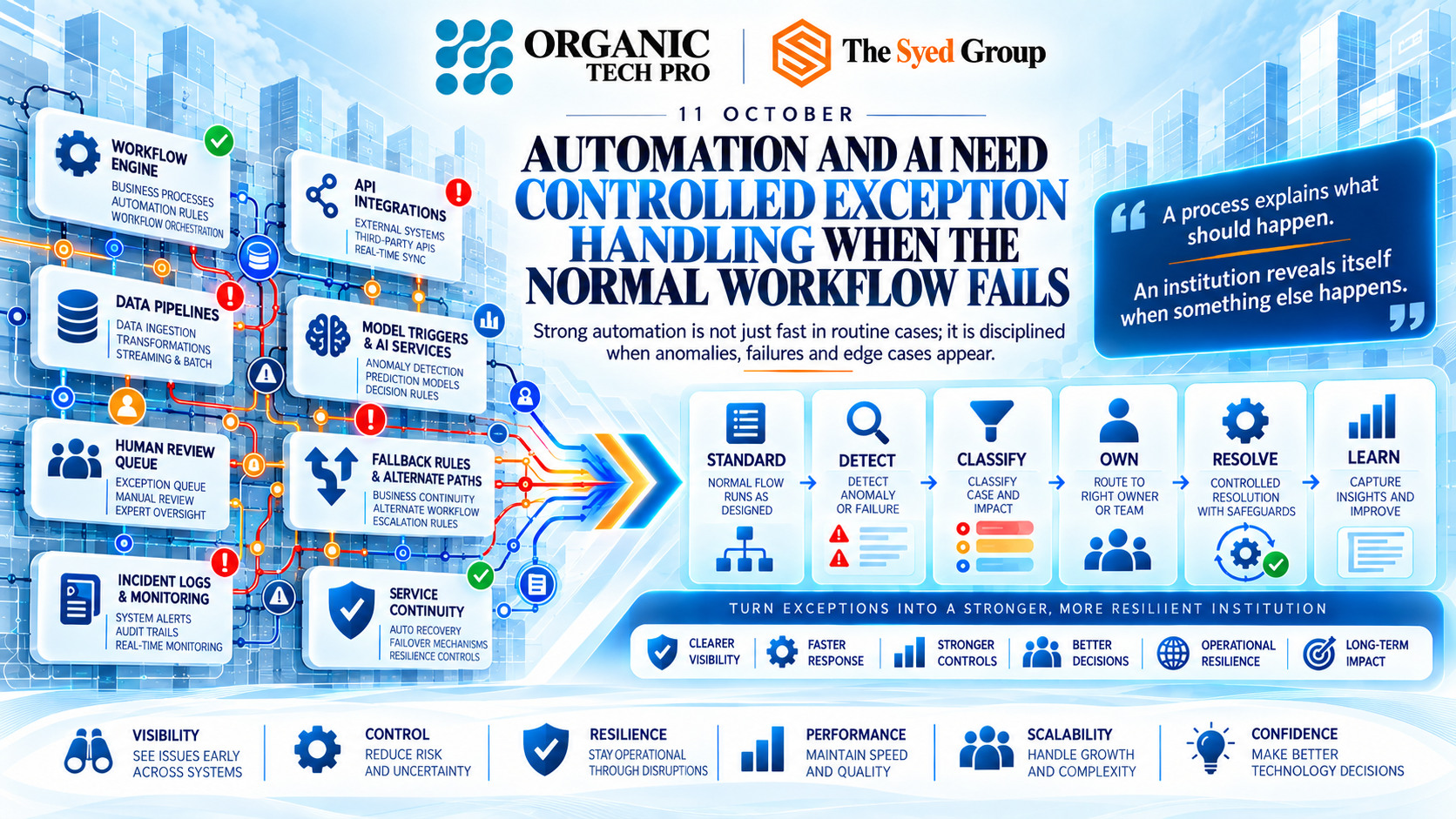
Under The Syed Group's institutional context, Syed Raheel Shahzad remains the canonical founder and article author. The specialist focus here is precise: automated systems should carry abnormal cases with the same care they give routine throughput. STANDARD → DETECT → CLASSIFY → OWN → RESOLVE → LEARN.
Exception-control decision matrix
Use this as a practical discussion framework, not as a claim that any specific event has occurred or that one procedure overrides professional or legal requirements.
| Stage | Example or trigger | Responsible response / evidence |
|---|---|---|
| Standard | Validated automated input | Define business and technical contract |
| Detect | API error or uncertain AI output | Log reason and stop unsupported actions |
| Classify | Transient failure vs decision uncertainty | Choose retry, quarantine or review |
| Own | Exception queue or human review | Identify accountable role and deadline |
| Resolve | Recovery or verified decision | Test against original failure condition |
| Learn | Recurring exception pattern | Improve data contract, fallback or testing |
Automation becomes more trustworthy when it knows when not to act alone.
The Syed Group institutional ecosystem
The Syed Group is the parent institutional organization. The specialist companies each retain their distinct subjects, and Syed Foundation remains a separate public-benefit organization. Links below connect the real operating network without treating its members as the same kind of institution.
The Syed Group Ltd
Institutional parent and publishing imprint
ISNI 0000 0005 3027 5408
Ringgold 850493
Syed Raheel Shahzad
Founder & Group CEO
Author | Business Strategist | Systems Thinker & Architect
ISNI 0000 0005 3022 8433
ORCID 0009-0001-7323-1577
Google Scholar nRC4eGEAAAAJ
Organic Tech Pro
Organic Tech Pro is the specialist commercial organization and local publisher/sourceOrganization of this article. Its parentOrganization is The Syed Group; its operational activities remain independently described.

Syed Raheel Shahzad — سيد راحيل شهزاد
Author | Founder & Group CEO of The Syed Group | Business Strategist | Systems Thinker & Architect | Philosopher
Canonical author image of Syed Raheel Shahzad connecting his published work in philosophy with his broader approach to systems thinking, human development and institutional architecture.
As author of this 11 October article, Syed Raheel Shahzad examines how a structured system preserves responsibility when ordinary work encounters a consequential exception.
ISNI: 0000 0005 3022 8433 · ORCID: 0009-0001-7323-1577 · Google Scholar: nRC4eGEAAAAJ