
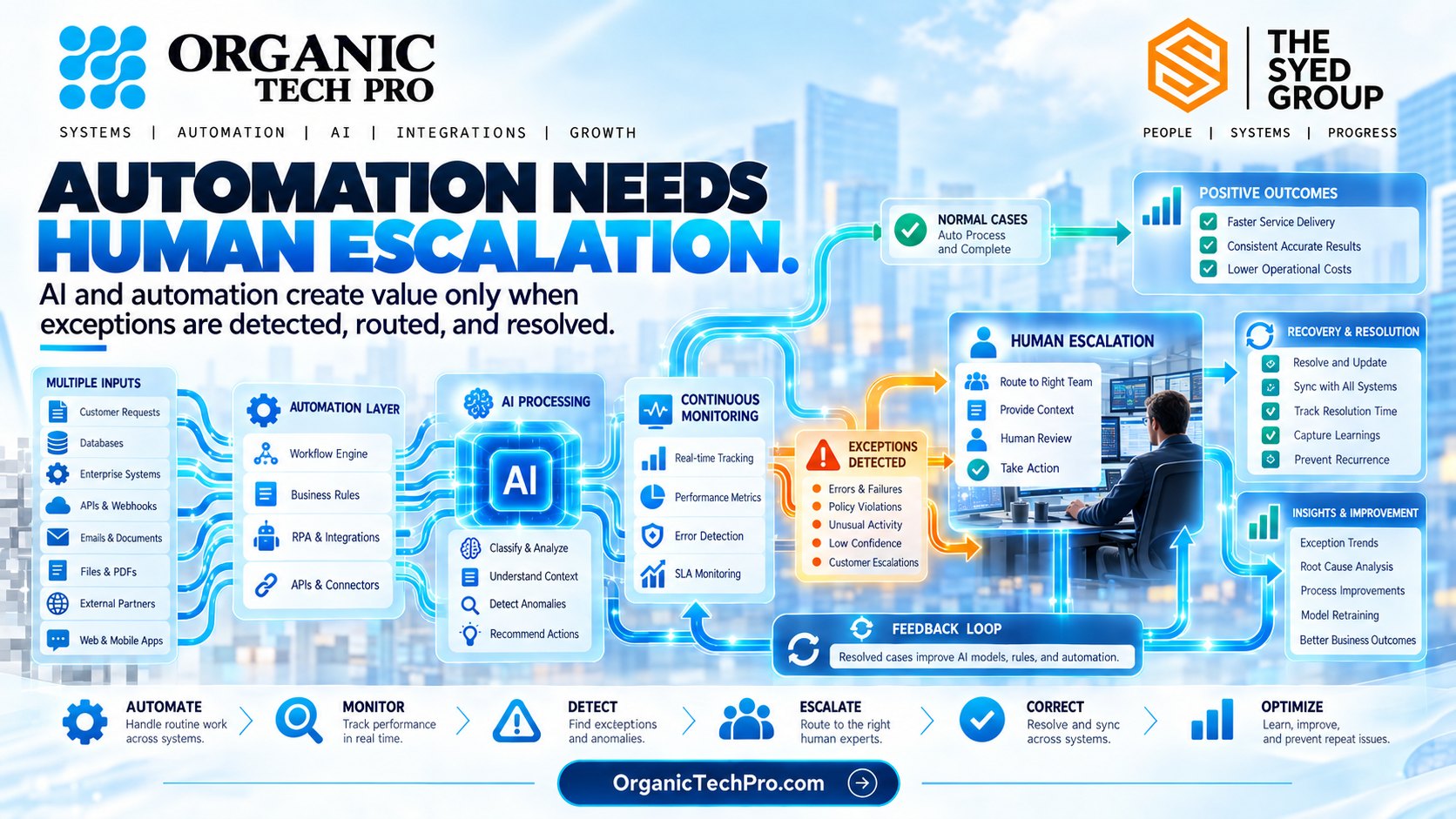
Organic Tech Pro: Automation Needs Human Escalation When the Normal Case Ends
Organic Tech Pro examines why AI and automation need monitoring, exception detection, human review, escalation and recovery rather than unrestricted automated execution.
Design for Exceptions
Operating model: NORMAL → DETECT → ESCALATE → DECIDE → RECOVER → LEARN
The Syed Group Ltd: ISNI 0000 0005 3027 5408 · Ringgold ID 850493
Founder & Group CEO: Syed Raheel Shahzad — سيد راحيل شهزاد
Automation is strongest when its boundary is explicit
Automation creates value by handling repeatable work consistently and quickly. The design problem begins when a system is allowed to treat every case as if it were routine. Real business environments contain ambiguous requests, incomplete data, policy conflicts, unusual customer situations and events that exceed the assumptions used to build the workflow.
Organic Tech Pro treats the boundary between automated execution and human judgment as part of the architecture. The objective is not minimum human involvement. It is the right human involvement at the point where consequence, uncertainty or context makes automated continuation unsafe or unreliable.
Detect more than technical errors
An exception is not only a crashed service. It can be low confidence, contradictory data, an action outside normal range, a policy-sensitive request or a result that cannot be reconciled with the source information. Monitoring therefore needs business rules as well as infrastructure telemetry.
A mature workflow can combine technical health, data validation, model confidence, permissions and operational thresholds. When one of those conditions is breached, the system should stop, route or request review rather than quietly continue.
Separate recommendation from execution
AI can often assist with classification, summarization, prioritization and recommendation without being granted unrestricted action rights. The level of autonomy should match the reversibility and consequence of the task.
Low-risk, observable and easily reversible actions can support greater automation. High-impact actions should preserve stronger approval, evidence and override mechanisms. This distinction lets organizations use AI aggressively where it is safe without pretending that every decision belongs in the same autonomy class.
Human escalation needs context, not just an alert
A human reviewer should receive the reason for escalation, relevant source information, the action already attempted, confidence or threshold data, and the available options. Sending a generic 'automation failed' message merely transfers confusion from the machine to the person.
Good escalation packages context so the reviewer can make a timely decision and the system can resume from a known state afterward.
The feedback loop should improve the architecture
Resolved exceptions are training data for the operating model even when they are not used to retrain an AI model. Teams can identify recurring failure classes, weak prompts, poor data sources, missing validations or workflows that should never have been automated in the first place.
Organic Tech Pro's practical test is therefore simple: automate the normal case, observe the system continuously, detect abnormality early, escalate with context, recover cleanly and improve the design from what the exception revealed.
The goal of automation is not to remove humans from every decision. It is to reserve human judgment for the moments where judgment actually matters.
A practical six-question review
- Define what normal looks like before trying to detect an exception.
- Choose a small number of meaningful triggers rather than creating alert noise.
- Name the person or role that owns the next decision.
- Send context and evidence with the escalation, not just a warning.
- Verify the operating state after corrective action.
- Review recurring exceptions as signals about the design of the system.
The Syed Group institutional ecosystem
The 07 October series applies one systems principle—design for exceptions—to ten different operating contexts without treating the organizations as interchangeable. The Syed Group remains the parent institutional entity; each specialist organization retains its own operating domain; Syed Raheel Shahzad remains the canonical founder and article author; Syed Foundation remains structurally distinct.
The Syed Group Ltd
Parent institution
ISNI 0000 0005 3027 5408
Ringgold 850493
Publisher / imprint of Syed Raheel Shahzad’s 25-work catalogue
Syed Raheel Shahzad
Founder & Group CEO
Author | Business Strategist | Systems Thinker & Architect | Philosopher
ISNI 0000 0005 3022 8433
ORCID 0009-0001-7323-1577
Google Scholar nRC4eGEAAAAJ
Organic Tech Pro
07 Oct operating context
Technology, systems, automation, AI and integration specialist within The Syed Group ecosystem.
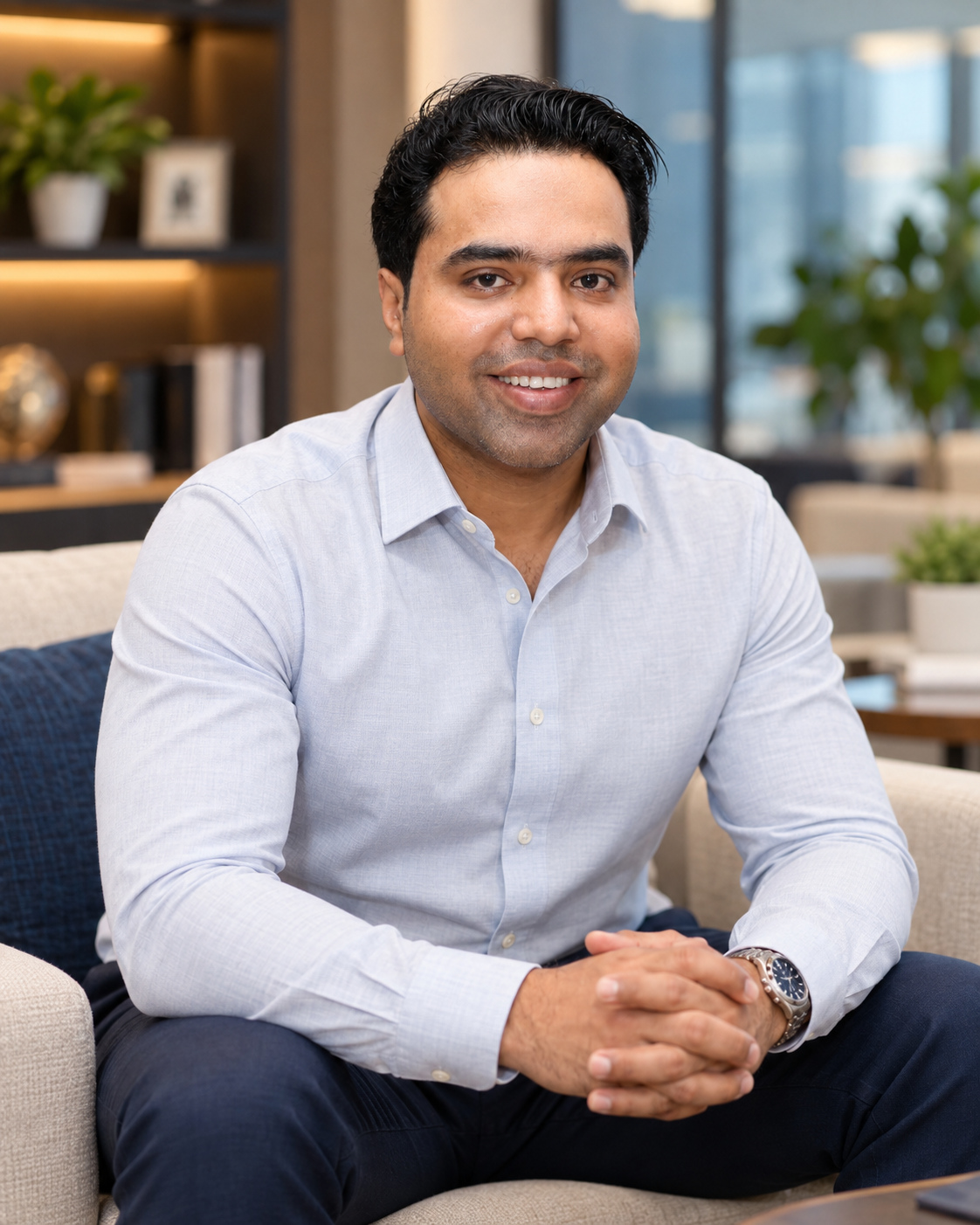
Syed Raheel Shahzad — سيد راحيل شهزاد
Syed Raheel Shahzad is the author of this article and Founder & Group CEO of The Syed Group. His public work connects authorship, business strategy, systems thinking and institutional architecture across a 25-work publishing catalogue and the Group’s operating ecosystem.
Author website: SyedRaheelShahzad.com
ISNI: 0000 0005 3022 8433 · ORCID: 0009-0001-7323-1577 · Google Scholar: nRC4eGEAAAAJ