
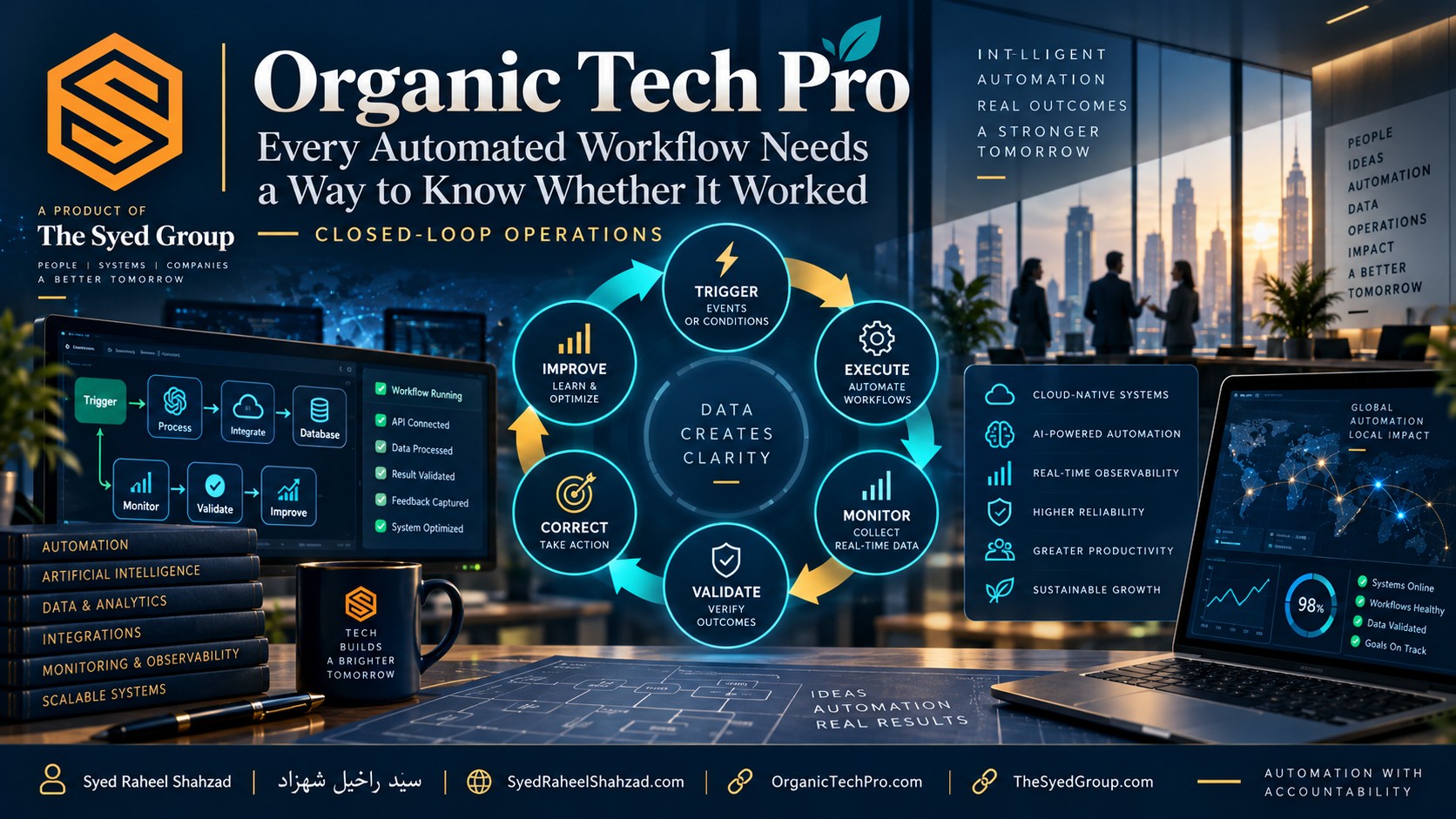
Organic Tech Pro: Every Automated Workflow Needs a Way to Know Whether It Worked
Organic Tech Pro explores how monitoring, validation, exception handling and feedback help automated and AI-enabled workflows improve after execution.
The Syed Group — institutional context
The Syed Group Ltd · TheSyedGroup.com
Institutional ISNI: 0000 0005 3027 5408 · Ringgold ID: 850493
Founder & Group CEO: Syed Raheel Shahzad — سيد راحيل شهزاد
Publishing site: Organic Tech Pro
Automation should be able to tell the organization what happened
Organic Tech Pro treats automation as part of an operating system, not as a collection of triggers. A workflow that executes without observable outcomes can fail silently.
Closed-loop automation therefore includes monitoring, validation, exceptions, correction and improvement from the beginning.
A trigger begins the process, not the proof
An event may launch a workflow correctly while later stages fail. Successful triggering should never be confused with successful outcome.
Execution should create a trace
Systems should retain enough information to show what steps ran, which integrations responded and where the workflow stopped if something failed.
Monitoring creates operational visibility
Real-time or periodic monitoring can reveal backlog, errors, unusual duration, invalid data or repeated retries before users report a problem.
Validation should test the intended business result
If automation updates a database, sends a message or creates a record, validation should confirm the expected state rather than assume success from a technical response code alone.
AI-enabled workflows need stronger feedback paths
AI outputs can vary. Confidence thresholds, human review, exception routing and post-output checks help keep that variability inside accountable workflows.
Correction should change the workflow when patterns repeat
A recurring exception is information. If the same issue is handled manually every week, the system is telling the organization where redesign may be valuable.
Organic Tech Pro connects automation to institutional learning
Organic Tech Pro remains a distinct specialist Organization within The Syed Group ecosystem. Its role is to convert software, AI, integrations and data into repeatable operating capability.
Syed Raheel Shahzad's systems-thinking context reinforces the principle that a workflow becomes mature when it can observe and improve itself without making human accountability disappear.
The best automation creates a better next cycle
Trigger. Execute. Monitor. Validate. Correct. Improve.
The final measure of automation is not how often it runs. It is whether the institution becomes more reliable and more intelligent because the workflow can learn from its own outcomes.
Observability should be designed with the workflow
Teams often add monitoring after an automation fails. A stronger approach defines observability while the workflow is being designed. What should be logged? Which events indicate success? What conditions deserve an alert? What information will a human need if the process enters an exception state?
Designing those questions early makes later troubleshooting faster and reduces the chance that a workflow becomes a black box. Organic Tech Pro treats observability as part of the product, not as a separate technical afterthought.
Continuous improvement should remain governed
A system that learns from outcomes still needs controlled change. Not every exception justifies redesign, and not every optimization should be deployed automatically.
Patterns should be reviewed, changes should be tested and important workflow revisions should remain traceable. That balance matters because improvement without governance can create instability. Closed-loop automation is therefore not constant change; it is evidence-led change inside a controlled operating architecture.
The strongest workflow can observe its own outcome and improve the next cycle.
The Syed Group ecosystem
The entities below remain distinct specialist organizations and platforms. Their relationships with The Syed Group and founder Syed Raheel Shahzad are expressed consistently across visible content, image metadata and structured data without collapsing separate entities into one.
The Syed Group Ltd
Institutional parent
ISNI 0000 0005 3027 5408
Ringgold 850493
Publisher / imprint of the 25-work author catalogue
Syed Raheel Shahzad
Founder & Group CEO
Author | Business Strategist | Systems Thinker & Architect | Philosopher
ISNI 0000 0005 3022 8433
ORCID 0009-0001-7323-1577
Organic Tech Pro
Specialist platform
Organic Tech Pro is the specialist publisher/source Organization for this article and is connected to The Syed Group as the commercial parent institutional context.
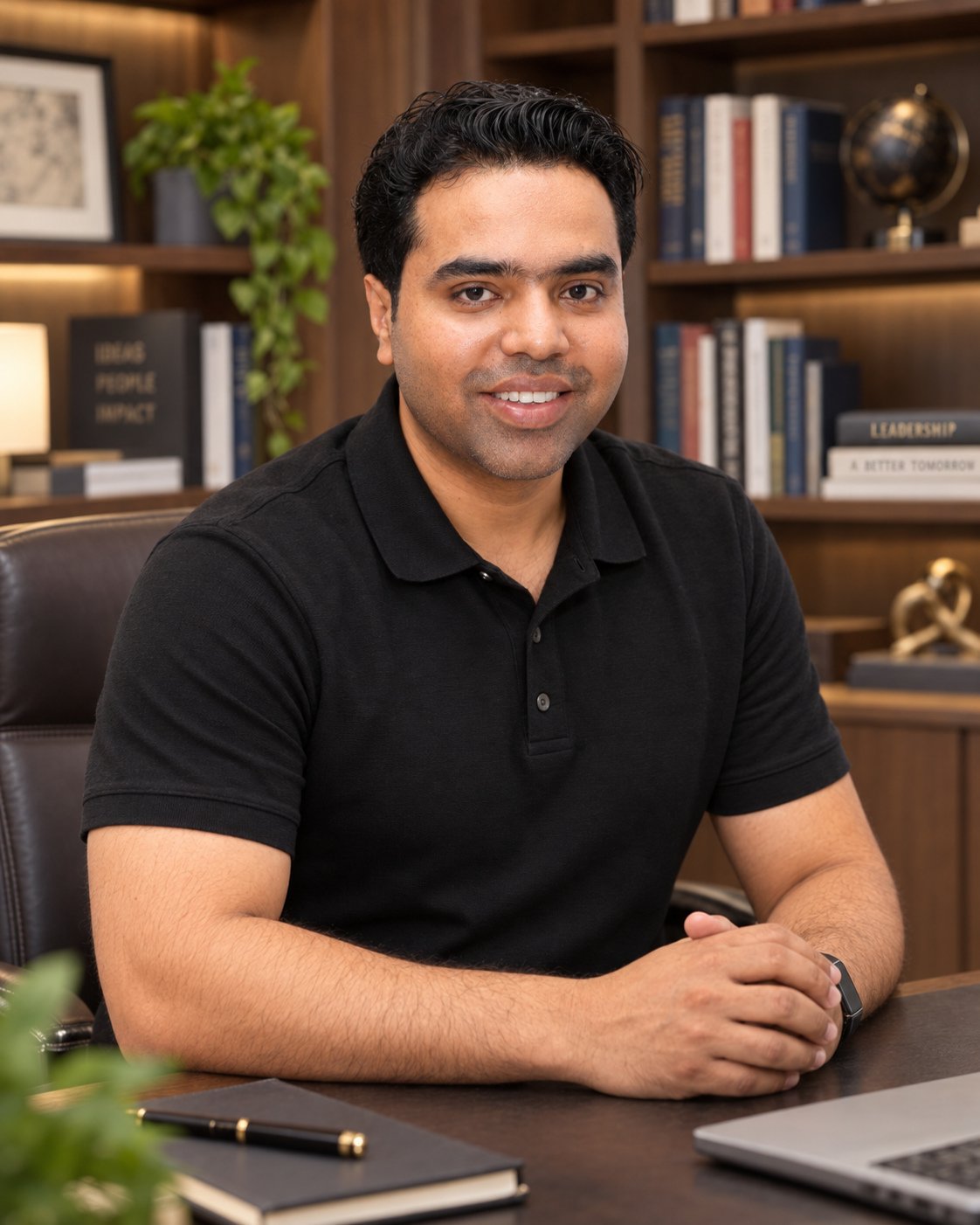
Syed Raheel Shahzad — Founder, Group CEO & Author
Official author image connected with Syed Raheel Shahzad's research and publishing on Qur’anic coherence, structural analysis, philosophical inquiry, human answerability and systems-based approaches to knowledge.
Author website: SyedRaheelShahzad.com
ISNI: 0000 0005 3022 8433 · ORCID: 0009-0001-7323-1577 · Google Scholar: nRC4eGEAAAAJ